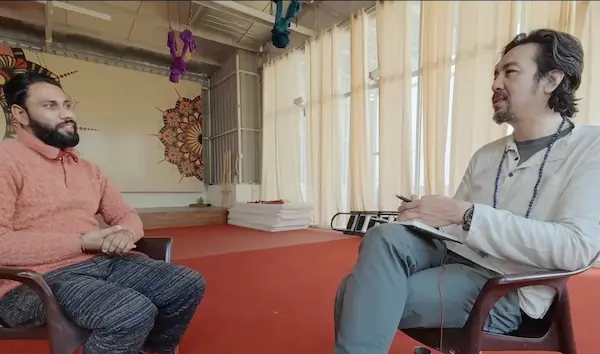
Watch the full interview with Lahki here:
I met Lakhi Ram during a yoga teacher training at Agni Yoga, a school nestled in the Tapovan area of Rishikesh — the stretch of the Ganges valley that has drawn seekers, scholars, and renunciants for millennia. Lakhi was our meditation and pranayama instructor. Quiet and precise in his teaching, he carried a depth that went well beyond technique. Between sessions I found myself wanting to hear more — not just about how to meditate, but about the living tradition behind it. So one afternoon, we sat down to talk.
What followed was a wide-ranging conversation that moved from the symbolic meaning of 108 mala beads to stories of solitary yogis in Himalayan snowfields, from the architecture of samadhi to the simple question that haunts every serious practitioner: What is actually real?
From the Mountains to the Mat
Lakhi grew up in the mountains above Rishikesh, in a small village called Poni Basar. He came to the city at nineteen to study yogic science, first completing a post-graduate diploma, then a two-year master’s degree, followed by a 500-hour teacher training. He has been teaching since 2016 — Hatha yoga asana, pranayama, meditation, and yoga philosophy.
But meditation, he told me, was where his teachers saw something in him. At the university, instructors assess each student’s temperament and advise them toward the branch of yoga that suits their nature. Some were guided toward anatomy, others toward asana teaching or philosophy. Lakhi was told he was suited for meditation. So he went deeper, studying not only at the university but with independent teachers and yogis throughout the region.
The Number 108
One of the first things that struck me in Lakhi’s classes was the japa meditation practice — sitting with a mala (a string of 108 beads) and repeating a mantra with each bead. I asked him about the number.
His answer was unexpectedly layered. The number 108, he explained, can be read as the product of three, five, and one hundred — though “product” here is symbolic, not arithmetic. Three represents the three qualities of the mind in yogic philosophy: sattva (the calm, pure state), rajas (the enthusiastic, active state), and tamas (the dull, inert state). Five represents the five elements that compose the body — earth, water, fire, air, and space (Indian philosophy adds space where Western traditions typically stop at four). And one hundred represents the completeness of the self — the dimension that is beyond body and mind entirely.
“This is complete, that is complete. From completeness, completeness comes — and still, that remains complete.”— Lakhi Ram, reciting the Purnamada mantra
There are other interpretations too, he noted: 108 major nadis (energy channels) in the body, or the claim that the distance between the Earth and Sun is 108 times the Earth’s diameter. But the symbolic reading — body, mind, and spirit — is the one that resonates most in practice.
Yoga Is Not a Religion
I pressed Lakhi on a question that interests me both as a psychologist and as someone raised in a Western context: what is the relationship between yoga and Hinduism? Is yoga a religious practice?
His answer was nuanced. The roots of yoga, he said, lie in the Vedas — the foundational texts of Hindu philosophy, more than five thousand years old. The Vedas contain mantras, techniques, and references to gods and deities. But yoga as a systematic discipline was codified by Maharishi Patanjali in the Yoga Sutras — a text at least three thousand years old, predating the Buddha — and here the emphasis shifts.
In Hindu devotional practice, you worship. In yoga, you practice. You work through your body, your breath, your mind, and eventually you discover whatever reality is — not because a teacher told you what it is, but because you experienced it directly.
Lakhi offered a phrase in Hindi that stayed with me: gyan tammanu — “first know, then trust.” Don’t believe what someone else has experienced. Practice. Discover your own reality. Patanjali, he pointed out, never gave God a specific name or form. The instruction was simply: experience for yourself.
“Yoga don’t ask you to just trust in this or trust in that. Here you meditate by yourself. You do the practices — and then find your own reality.”— Lakhi Ram
Dharana, Dhyana, Samadhi — The Inner Architecture
Lakhi walked me through the internal stages of yogic meditation as described in Patanjali’s system. The first five of the eight limbs — yama, niyama, asana, pranayama, pratyahara — are considered “external yoga,” the preparation. The inner journey begins with dharana (concentration), moves into dhyana (sustained meditation), and culminates in samadhi (absorption).
The progression is specific. In dharana, you are training your wandering mind to stay on a single point — a mantra, the breath, a candle flame. In dhyana, the focusing becomes more fluid; there is awareness of three things: the object of meditation, yourself as subject, and the process connecting the two. In samadhi, the awareness of subject and process falls away entirely. Only the object remains — and eventually, even that dissolves into what Patanjali calls nirbija samadhi, the “seedless” state: pure awareness without thought.
When I asked Lakhi whether he had experienced samadhi, his answer was refreshingly honest. He has experienced the benefits of meditation — physically, mentally, in his quality of life — but samadhi, as described in the original texts, is a lifelong process. He was wary of anyone who claims it comes quickly.
Kundalini — The Sleeping Princess
Our conversation turned to Kundalini — the dormant energy said to be coiled like a serpent at the base of the spine. Lakhi explained the symbolism: the three and a half coils represent the three states of consciousness (waking, sleeping, dreaming), while the half-coil — the serpent lifting its head — symbolizes the energy’s drive toward awakening.
He used a beautiful metaphor I hadn’t heard before: Kundalini is like a sleeping princess. Before you wake her, everything must be prepared — the rooms cleaned, the path cleared. In yogic terms, this means purifying the body through shatkarma (cleansing practices) and nadi shodhana (channel purification through breath). Without this preparation, awakening can be destabilizing.
He cited Swami Satyananda Saraswati’s own account: even for this accomplished yogi, the Kundalini awakening was overwhelming. He lost consciousness by the Ganges and woke in his guru’s ashram, changed. Lakhi’s point was clear — this is powerful territory. Under proper guidance and with gradual preparation, it unfolds safely. Without that, it is genuinely risky.
The Babas — A Different Kind of Homelessness
Perhaps the most vivid part of our conversation was about the Babas — the wandering renunciants who appear throughout India, often with saffron robes and long beards, owning nothing, attached to nothing.
Lakhi told me about a yogi who lived in a small hut near a mountain temple above his village. It was winter, heavy with snow. The man had nothing — some black tea, water, and whatever food visitors brought him. People left money at his feet out of respect; he called it garbage. When the village children asked for his blessing, he refused at first: blessings, he said, are just a scheme. When they insisted, he relented. When they asked what they could do for him, he answered simply: you cannot do anything for me — whatever you can do is for yourself.
“Whatever you can do, it is for yourself. Whatever I can do, this is for myself.”— A Himalayan yogi, as recalled by Lakhi
Another Baba in his village used to meditate standing on one leg for hours, supported only slightly by the other. He taught children drumming, singing, harmonium, headstands — seemingly at random, whenever the impulse struck. When the children asked him what he experienced during those long solitary hours, he said simply: I feel happy. In Indian philosophy, Lakhi reminded me, the ultimate realization is ananda — not ecstasy or bliss in the sensational sense, but a deep, abiding happiness that needs no external cause.
I asked Lakhi how this tradition looks from the outside — because in the West, a person with no home, no family, no possessions, and no job is not a respected figure. He is a failure, associated with addiction and misfortune. Lakhi acknowledged the difference. In India, these renunciants are respected not for status or wealth but for their presumed spiritual wisdom. People give freely to them — not as charity, but as an offering to something they recognize as valuable.
Meditation Here vs. Meditation There
I asked the obvious question: why come to India for meditation when you can practice at home in Europe or the United States?
Lakhi’s distinction was sharp. In the West, meditation has largely been adapted for health and relaxation — and that’s legitimate. Twenty minutes of mindfulness can reduce stress, improve sleep, sharpen focus. But in the traditional Indian context, the purpose goes further. The practices were not designed for wellness. They were designed for self-discovery — for confronting the question of who you actually are beneath your identities, roles, and conditioning.
The word he used was sat-naam: your true name, your true nature. Not your social identity or psychological profile, but something more fundamental. Here, meditation is not a tool for optimization. It is a method of investigation.
The Tilak as Meditation Tool
Near the end of our conversation, Lakhi showed me something I had seen a thousand times in India without understanding it — the tilak, the mark placed on the forehead between the eyebrows. He pulled out a small case of sandalwood paste and explained: in yogic tradition, the tilak is not merely decorative or religious identification. It is a meditation tool.
The mark begins at the ajna chakra — the point between the eyebrows. As a practitioner’s awareness and Kundalini energy rise through practice, the tilak is placed progressively higher, moving toward the crown. The length and position of the mark indicates, symbolically, where the practitioner’s consciousness currently rests. You can see this in the long vertical tilaks worn by some sadhus — stretching from the brow center all the way to the hairline, a visible map of the inner journey.
What to Read
Before we parted, I asked Lakhi for book recommendations — a question every student asks, and one that reveals a teacher’s lineage and temperament. His choices were all from the Bihar School of Yoga tradition:
- Meditation from the Tantras — by Swami Satyananda Saraswati (on meditation)
- Prana and Pranayama — Bihar School of Yoga (on breathwork)
- Four Chapters of Freedom — a commentary on the Patanjali Yoga Sutras (on philosophy)
Closing Thoughts
What stayed with me most from this conversation was not any single technique or concept, but a quality of orientation. Lakhi’s tradition doesn’t ask you to adopt a belief system. It asks you to investigate — carefully, patiently, over a lifetime. The phrase gyan tammanu kept returning to me in the days afterward. Know first, then trust. It is a radical position, really — one that honors personal experience over doctrine, and patience over speed.
As a psychologist, I find deep resonance in this. The therapeutic process, at its best, is also an investigation — not a prescription of what to feel or believe, but an invitation to look closely, withstand uncertainty, and discover what is actually there. Different languages, different traditions, but a shared commitment to the primacy of direct experience.
That afternoon in Rishikesh, with the sounds of the Ganges somewhere below and the mountains somewhere above, I think both of us were doing the same thing: trying to see clearly, and trusting that the seeing itself is enough.