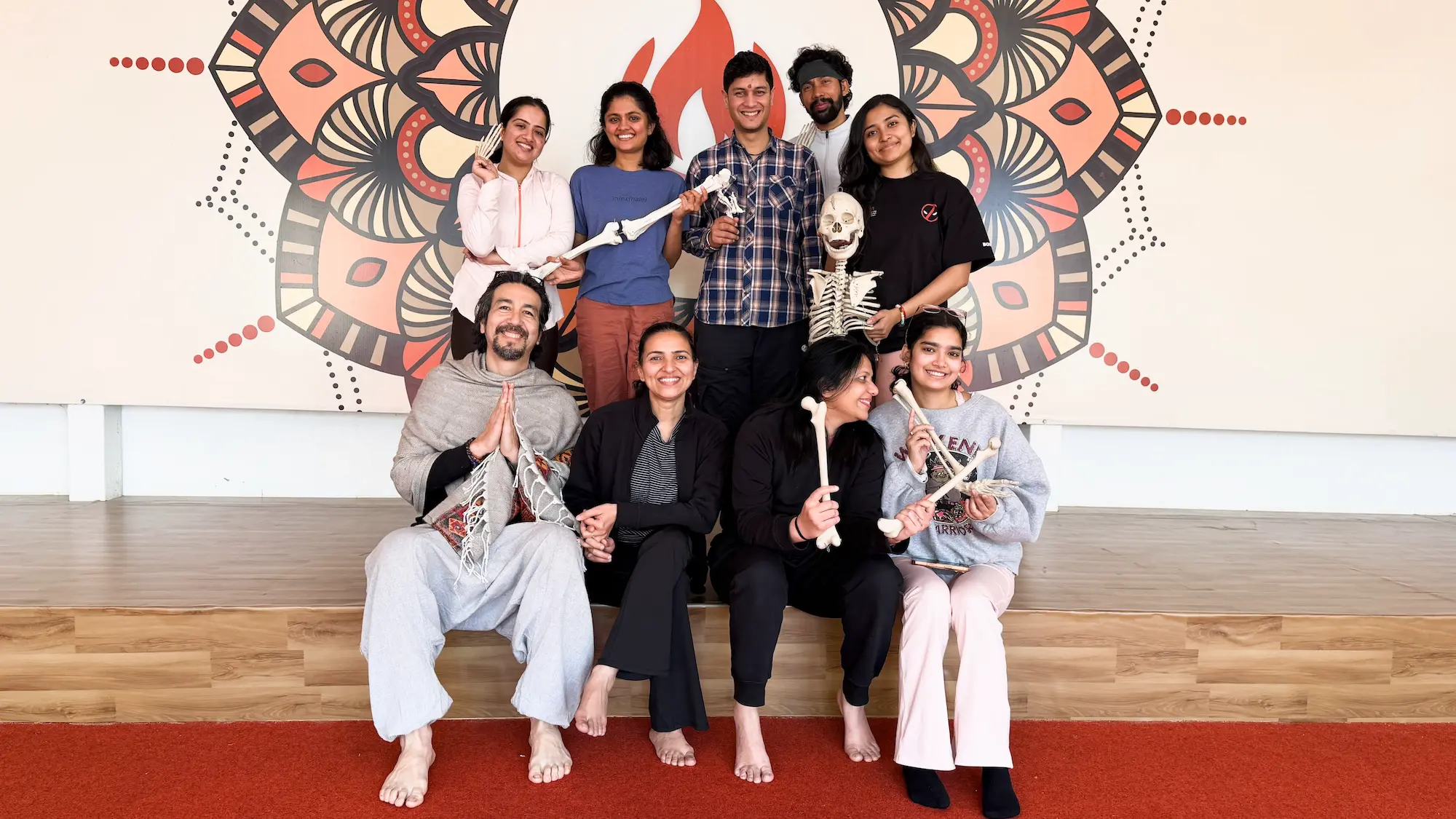
Recently I have attended the 200 hour Yoga Teacher Training in Rishikesh, India. I arrived to Rishikesh without really knowing where to go or what to do, however I was clear I wanted to study something. Rishikesh is full of yoga schools, in the northern area of town there is almost a yoga school on every corner. Lots of spiritual related activities, kirtans and temples all over the place. After looking into a couple of schools I ended up signing up to a Yoga Teacher Training without really knowing what it was. I thought it was mostly a Hatta Yoga and Asana training to make you a yoga teacher however it ended up being a very profound training with a deep immersion into yogic science and yogic philosophy.
Indians take yoga seriously and schools can be very intense, classes at 6am in the morning until 7pm with a 3 hour break in the middle from Monday to Saturday. And Sundays usually no class but some yoga activity like aerial yoga, acroyoga or doing yoga in the Ganges beach. The intensity plus the spiritual environment in Rishikesh compounds a rich and transformative immersion into what Yoga really is.
A Transcendent Psychology Perspective
Why Yogic Philosophy Matters Today
Modern psychology studies cognition, emotion, behavior, trauma, and identity. Yogic philosophy goes further: it asks a more radical question: Who is the one experiencing all of this?
Throughout history yogis have used yoga to explore consciousness. They have gone through deep insight journeys where they have discovered the intricacies of consciouness, writing books and deepening the understanding of self.
Rooted in the Vedas and the Upanishads which are more than 4000 years old, this yogic philosophy proposes that the human being is not fundamentally a body or a personality, but consciousness itself.
The exploration of consciousness it not something new, modern psychology understanding of consciousness feels like preschool when compared to the vast knowledge of yogic philosophy. For a psychology concerned with transformation, regulation, trauma healing, and identity restructuring,
The Core Principle: The Divinity of the Soul
At the heart of yogic philosophy lies a bold and transformative proposition:
The essence of the human being is not broken, sinful, or fundamentally deficient — it is inherently whole.
This insight is expressed in the ancient formula Atman = Brahman. Atman refers to the deepest Self — not the personality, not the roles we play, not even the stream of thoughts we experience. Brahman refers to ultimate reality — pure, unconditioned consciousness, the ground of all existence. To say Atman equals Brahman is to say that the deepest layer of your being is not separate from the deepest layer of reality itself.
Brahman consciousness is described as pure awareness — free from conditioning, free from psychological fluctuations, untouched by trauma, memory, or narrative. It is not something mystical floating elsewhere. It is the simple fact of awareness that makes every experience possible. Brahmnan can be also understood as The True Self.
This principle radically shifts how we understand identity.
Most of us grow up identifying with what changes: our history, our wounds, our achievements, our fears. Over time, we begin to say, “This is who I am,” referring to patterns shaped by family, culture, and personal experience. Yogic philosophy gently challenges this assumption. It suggests that what we call identity is often a layer of conditioning placed upon a deeper, stable awareness.
In psychological language, identity confusion arises from misidentification. When we mistake temporary mental states for the core of who we are, instability follows. If I believe I am my anxiety, then when anxiety arises, my entire sense of self is threatened. If I believe I am my trauma history, then I remain unconsciously organized around it. This is a topic that modern therapies also explore, like IFS where the awareness of inner parts unveils conditioning and identification with distorted layers of self.
Suffering arises from the ignorance of one’s true nature
From the yogic perspective suffering, arises from ignorance of one’s true nature — not ignorance in a moral sense, but in a perceptual sense. We simply do not see clearly what we are.
Healing, therefore, is not the process of adding something new to ourselves. It is not about manufacturing worthiness or constructing a better ego structure alone. It is about uncovering what has always been present beneath layers of identification.
This perspective does not deny trauma, conditioning, attachment wounds, or nervous system dysregulation. Yogic philosophy does not claim that psychological pain is imaginary. Rather, it reframes these as movements within consciousness — real experiences, but not the essence of the experiencer.
When this moves from intellectual understanding to lived experience, something changes. Self-criticism softens. Fear loses its absolute grip. There is more space around thoughts, more stability beneath emotion.
The work of yoga, then, is not self-improvement in the conventional sense. It is self-recognition.
Yoga as Science, Not Belief, Not Religion
Yogic philosophy does not present itself as dogma. It proposes:
- Direct verification through experience.
- Systematic methods.
- Reproducible inner states.
In this sense, yoga functions as an empirical inner science, not a science that uses mathematics, formulas or scientific models, but a science that is a systematic, experiential discipline for investigating consciousness. In that sense, it functions as an inner science.
Was Yoga a Science in Antiquity?
In ancient India, yoga was considered part of śāstra — a structured body of knowledge governed by method. Texts like the Yoga Sutras of Patanjali outline a clear framework:
- A defined problem (mental fluctuations, suffering).
- A hypothesis (ignorance of true nature causes suffering).
- A method (ethical discipline, breath regulation, concentration, meditation).
- A predicted outcome (clarity, liberation, stable awareness).
This structure resembles a research protocol — but the laboratory was the human nervous system and the instrument was trained attention.
Ancient practitioners did not use EEG machines or neuroimaging. Instead, they relied on disciplined introspection, sustained meditation, and teacher-student transmission to validate results. States of consciousness were mapped, categorized, and refined over centuries.
In that context, yoga was understood as a science of consciousness, not a belief system.
The laboratory: the mind.
The instrument: attention.
The experiment: meditation.
The hypothesis: consciousness is not limited to the ego.
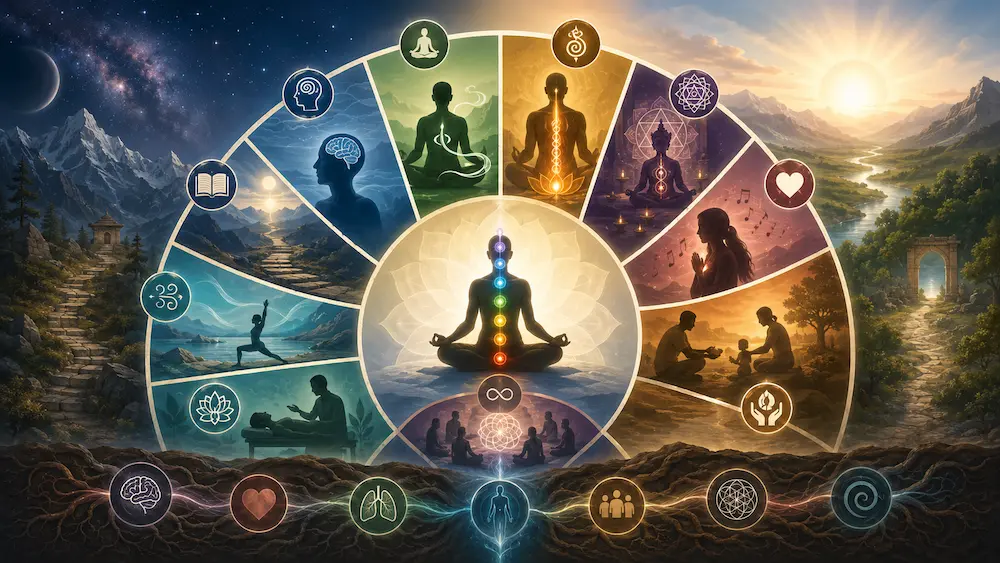
The Four Pathways of Yoga
Every yogic school will teach the Four Pathways of Yoga which were systematized by Swami Vivekananda systematized yoga into four complementary paths. Each corresponds to a psychological orientation.
1. Jnana Yoga — The Path of Insight
- Inquiry into the nature of Self.
- Deconstruction of false identity.
- Cognitive discrimination between the changing and the unchanging.
Psychological parallel:
Metacognition, cognitive defusion, identity restructuring.
Core question:
If thoughts, emotions, and sensations change — who is aware of them?
2. Karma Yoga — The Path of Action
- Selfless action.
- Non-attachment to outcomes.
- Work as spiritual practice.
Psychological parallel:
Values-based action, service orientation, reduction of ego-driven striving.
Core insight:
Attachment to results creates suffering; aligned action creates freedom.
3. Bhakti Yoga — The Path of Devotion
- Love directed toward the Absolute.
- Emotional purification.
- Surrender of ego rigidity.
Psychological parallel:
Attachment repair, trust, relational transcendence.
Devotion, properly understood, reorganizes emotional life around meaning rather than fear.
4. Raja Yoga — The Path of Meditation
- Regulation of attention.
- Mastery of mental fluctuations.
- Direct realization through stillness.
Psychological parallel:
Nervous system regulation, attentional training, integration of fragmented mental processes.
Raja Yoga outlines an eightfold method:
- Ethical foundation
- Breath regulation
- Sensory withdrawal
- Concentration
- Meditation
- Absorption
This is a structured psychology of consciousness developed thousands of years before modern neuroscience.
5. The Concept of Maya: The Psychology of Misidentification
A central idea in yogic philosophy is Maya — the illusion created by identification with name and form.
In contemporary terms:
- Identification with roles.
- Fusion with narrative identity.
- Over-identification with trauma history.
- Mistaking conditioned patterns for essence.
Maya does not mean the world is unreal. It means the way we interpret reality is distorted by conditioning.
Liberation is not escape from life — it is freedom from misperception.
6. Strength as a Spiritual Principle
Vivekananda emphasized strength repeatedly. Weakness, in this framework, is not moral failure but misperception.
From a transcendent psychology lens:
- Chronic shame weakens identity.
- Learned helplessness distorts agency.
- Disconnection from deeper Self creates fragmentation.
The yogic response is radical:
Reclaim the awareness that precedes conditioning.
This does not bypass trauma. It creates a stable center from which trauma can be integrated.
7. Transcendent Psychology: Bridging Ancient and Modern
At transcendentpsychology.com, our work integrates:
- Nervous system regulation
- Trauma-informed approaches
- Parts work and identity layers
- Spiritual inquiry
- Yogic philosophy
Yogic science provides a vertical dimension — a model of consciousness that extends beyond personality.
Psychology helps stabilize and integrate the horizontal dimension — behavior, relationships, embodiment.
The integration of both creates:
- Depth without dissociation.
- Strength without denial.
- Spirituality without dogma.
- Psychology without reductionism.
8. The Central Insight
The deepest claim of yogic philosophy is not mystical — it is existential:
You are not merely a collection of experiences.
You are the field in which experience arises.
When this shifts from concept to realization, fear reorganizes, attachment softens, and action becomes clearer.
This is not belief.
It is inquiry.
It is practice.
It is realization.
My time in Rishikesh ultimately revealed that yoga is far more than a physical discipline or a certification to teach postures. What began as a somewhat spontaneous decision to enroll in a training became an immersion into a sophisticated system for understanding consciousness and human identity. Living within that rhythm—early morning practice, long philosophical discussions, meditation, and the quiet presence of the Ganges and the Himalayas—made it clear why yoga has endured for thousands of years. It is not merely a cultural tradition or a set of techniques; it is a structured path of inquiry into the nature of the self. From the perspective of transcendent psychology, the encounter with yogic philosophy reinforces a powerful insight: psychological healing and spiritual realization are not separate processes but different dimensions of the same exploration. Rishikesh, in this sense, was not just a place to study yoga—it was a reminder that the deepest work of transformation begins when we start questioning who, or what, is truly experiencing our lives.