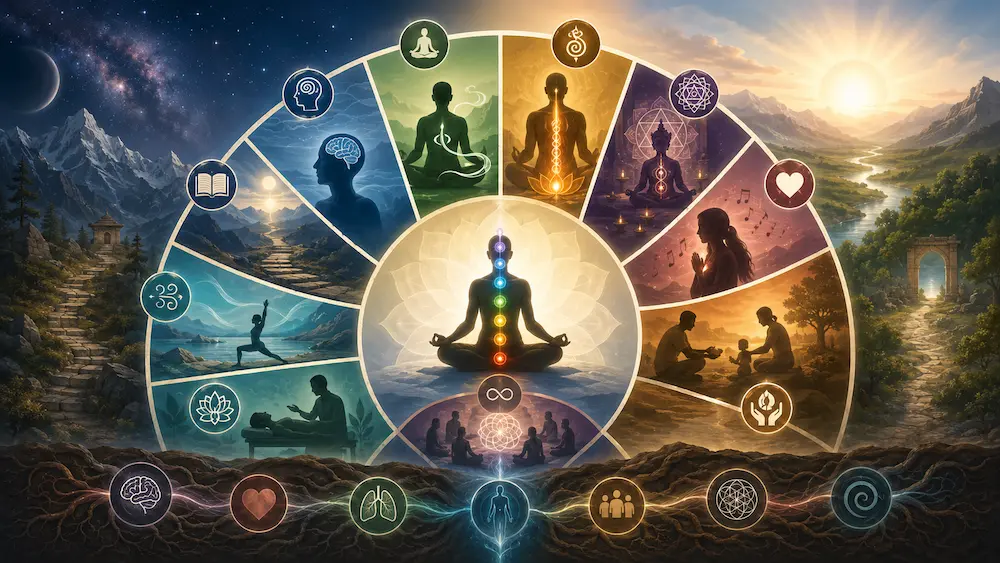
Speaking about Self can be a hypothetical field that sounds more spiritual than psychological.For psychology, the self has been the object of study, and it is labeled with different names, ego, identity, personality, etc. In my approach here in Transcendent Psychology the Self with capital S is the center, where everything occurs and the variable that we work with to engage in transformation. In order to ground the borderline spiritual concepts that I use throughout my teachings, I decided to research in depth the scientifical and evidence based perspective of Self. That is why In this article I decided to dig deep into the scientific, evidence based approach to Self in order to integrate the spiritual understanding with the scientific or psychological understanding of Self.
Multi-Level Models of the Self in Psychology
Classic and contemporary psychology recognizes that the “self” is not monolithic but comprises multiple facets or levels. Over a century ago, William James (1890) distinguished several aspects of the empirical self: a material self (one’s body, possessions, family), a social self (our identity in the eyes of others), and a spiritual self (our inner subjective being), along with a sense of a pure ego or “I” . James observed these selves in a hierarchy – with the bodily/material self at the bottom and the spiritual self “supremely precious” at the top – and noted that people will sacrifice lower needs (physical comfort, social approval) in favor of preserving their higher or “true” spiritual self . This early model aligns closely with the Four Selves concept (material, social, true, higher self) by demonstrating a layered view of identity from the tangible to the transcendent.
Modern psychology continues to explore multi-level self constructs. For example, research in personality and social psychology has examined the notion of a “true self.” Newman, Bloom & Knobe (2014) found that people intuitively believe everyone has a core true self that is morally good and authentic, distinguishing it from more surface-level traits or behaviors . In clinical theory, D. W. Winnicott introduced the idea of a True Self versus a False Self, where the true self represents one’s real, alive inner core of personality and the false self is a defensive facade shaped by social expectations . These concepts support the Four Paths model by highlighting an authentic inner self beneath social personas. Humanistic psychologists like Carl Rogers also spoke of an ideal self vs. real self and stressed the importance of living congruently with one’s true self to achieve psychological well-being (as when one’s self-image aligns with the true inner self). Across these theories, the self is viewed as stratified – from outward material and social identities to an inner authentic self – providing a theoretical backbone for the model of Material, Social, True, and Higher selves.
Ego Development and Psychological Maturation
Developmental psychology offers evidence that the “self” can mature through levels of ego development, moving toward more integrated and expansive stages. Jane Loevinger’s theory of ego development delineates a sequence of stages from infancy through advanced adulthood, each marked by greater complexity, empathy, and inner cohesion . Her model (expanded by Cook-Greuter) spans preconventional levels (impulsive, self-protective stages), conventional levels (conformist, self-aware, conscientious stages), and postconventional levels (individualistic, autonomous, and ultimately a fully integrated or “unitive” stage) . Notably, research using Loevinger’s model finds that while most adults stabilize at the conventional stages, only about 10% reach the highest postconventional stages of ego maturity . These highest stages involve a more unified, transcendent sense of self (“unitive” ego) that resonates with the idea of a Higher Self. In other words, empirical studies of ego development support the notion of multiple levels of self – from the personality bound by social conventions to a more evolved self that transcends ego boundaries and integrates broader perspectives .
Other stage models echo this multi-level maturation. Robert Kegan’s adult development theory, for instance, describes a progression from a socialized self (defined by others’ opinions and societal norms) to a self-authoring mind (guided by one’s own values and identity) and eventually a self-transforming mind capable of seeing beyond its own frame of reference – a stage akin to transcending the ego. Similarly, Abraham Maslow postulated a hierarchy of needs culminating in self-actualization and later spoke of self-transcendence (going beyond the personal self to connect with higher values or purpose). These developmental perspectives provide theoretical validation for the Four Paths training: they suggest that human beings can cultivate higher levels of self (with greater authenticity, wisdom, and integration) beyond the material and social ego layers.
Evidence for Key Therapeutic Methods in the Four Paths Training
Internal Family Systems (IFS): IFS is a psychotherapy modality directly aligned with multi-part and multi-level self models. Founded by Richard Schwartz, IFS posits that the mind is an “internal system” of sub-personalities or “parts,” often divided into vulnerable parts (exiles) and protective parts (managers, firefighters), all overseen by a core Self . This view validates the idea that we do not have a single, unitary ego, but rather a family of selves within – analogous to the Four Selves model recognizing different aspects of self. IFS therapy helps clients access the compassionate Self to heal and harmonize their inner parts. While IFS originated in the 1990s, only recently has empirical research begun to catch up. A 2024 review in the Journal of Psychotherapy notes a “strikingly small evidence-base” so far, but early studies show promising results: IFS has been associated with symptom improvements in depression, chronic pain, PTSD, and trauma-related dissociation . For example, pilot trials have found IFS-based treatments can reduce depression and PTSD symptoms, and increase self-compassion, in comparison to control conditions . These emerging studies support IFS as a valid, non-pathologizing approach – one that treats inner “parts” with respect – which lends scientific credibility to working with multiple self-aspects as done in the Four Paths training. (IFS’s growing popularity in clinical practice also reflects its perceived effectiveness in addressing entrenched personality patterns by unburdening wounded parts and fostering an integrated Self.)
Somatic Experiencing (SE): The Four Paths emphasize the material/physical self, and Somatic Experiencing – a body-based trauma therapy developed by Peter Levine – provides an evidence-based foundation for including the body in psychological healing. SE operates on the principle that traumatic stress is often “held” in the body and can be released through tuning into bodily sensations and restoring nervous system regulation. A 2021 scoping review of SE research found promising findings that SE is effective in reducing post-traumatic stress symptoms, depression and anxiety, psychosomatic issues, and in improving overall life quality . For instance, randomized trials have reported that even brief SE interventions significantly lowered PTSD symptoms in trauma survivors compared to controls . The review notes that SE appears broadly applicable (across cultures and in combination with other therapies) and highlights specific body-awareness mechanisms as key therapeutic factors . While it concludes the evidence base is still early and further rigorous studies are needed, current data support SE’s core premise: attending to bodily experience can facilitate psychological healing. This lends empirical support to the School of the Four Paths’ inclusion of somatic work – recognizing the material, bodily level of self as crucial in trauma therapy and personal growth.
Ontological/Existential Inquiry: Another pillar of the Four Paths training is deep inquiry into one’s existence – exploring meaning, purpose, and the nature of self (often referred to as ontological inquiry). This approach is grounded in existential psychotherapy and meaning-centered counseling, which have a long clinical tradition. Viktor Frankl’s Logotherapy is a prime example: it focuses on helping individuals discover meaning in life as a primary therapeutic goal. Modern reviews of logotherapy find that it has measurable benefits. In a recent literature review of studies (2012–2022), logotherapy interventions were generally effective at improving well-being, especially when delivered in group therapy formats . Clients who engage in meaning-focused exercises often report greater resilience and reduced feelings of emptiness or despair. The review concludes that logotherapy is a valid therapeutic method for fostering personal purpose and meaning, though it calls for more research in individual therapy settings . Likewise, Irvin Yalom’s work in existential therapy (e.g. addressing death anxiety, freedom, isolation, and meaninglessness) provides clinical evidence that confronting life’s “ultimate concerns” can alleviate neurotic symptoms and instill a stronger sense of the true self. In essence, the existential/ontological dimension of the Four Paths is supported by a body of psychological literature demonstrating that cultivating meaning and authentic identity correlates with improved mental health. Even outside the therapy room, researchers have noted that people with a strong sense of life meaning and authentic self-concept tend to have better psychological outcomes (higher well-being and lower depression) . All of this underlines the importance of existential inquiry in a well-rounded growth model: science agrees that nurturing the “inner” or true self and one’s sense of purpose is a key component of psychological maturation.
Integrating Psychological and Transpersonal Frameworks
The School of the Four Paths model explicitly bridges conventional psychology with transpersonal or symbolic frameworks – for example, using the Kabbalistic Tree of Life as a psychological map. There is precedent for this kind of integration in the literature. Annette Poizner (2012) describes applying the Tree of Life model in clinical practice as an “energy model” of the psyche, wherein the ten sefirot (spheres) correspond to essential human capacities that must be balanced for optimal mental health . In this framework, psychological qualities – like the ability to assert oneself as a hero or to surrender with humility – are mapped to specific symbolic pathways on the Tree, and mental health is seen as a state of free “flow” through all these channels . Poizner’s work shows how a traditionally spiritual symbol system can be reframed in a non-dogmatic, therapeutic context. Instead of doctrine, the Tree becomes a metaphorical schema to help clients identify imbalances (e.g. excess emotionality vs. detachment) and work toward a more integrated self . Such efforts lend credibility to the Four Paths’ use of symbolic maps: even within evidence-based practice, clinicians have successfully used symbols like the Tree of Life to illuminate psychological growth processes.
Transpersonal psychology as a whole provides academic support for including a “Higher Self” or spiritual dimension in self-development. Roberto Assagioli’s Psychosynthesis, for instance, was an early integrative psychology that explicitly posited a transpersonal Self above and beyond the personality. Assagioli’s model differentiates between the ordinary “I” (personal ego) and a higher Self, and views psychological growth as a process of synthesizing the lower, middle, and higher aspects of the psyche into a unified whole . He introduced the concept of a Higher or Transpersonal Self into psychotherapy, drawing on both Eastern spiritual wisdom and Western psychological science . Today, his ideas are considered a forerunner of evidence-based humanistic and transpersonal psychology, anticipating research on peak experiences and self-transcendence . Recent studies in positive psychology have indeed examined self-transcendence (experiencing oneself as part of a larger whole or spiritual cosmos) and found it correlates with positive outcomes such as greater life satisfaction, prosocial emotions, higher ego integrity, and even lower depression . For example, narrative psychology research by Reischer et al. (2020) defined self-transcendence as a feeling of connectedness to humanity and the cosmos, and noted it was linked to greater well-being, optimism, self-integration, and purpose in life . This empirical link between spiritual connectedness and mental health gives weight to the Four Paths’ inclusion of a Higher Self level: engaging with transpersonal themes (in a grounded way) can foster resilience and personal growth.
Finally, the use of archetypal and symbolic tools in psychotherapy – rooted in Jungian psychology – offers additional support. Jung’s concept of the Self (with a capital S) as the archetype of wholeness is often likened to a higher organizing center of the psyche, akin to the Higher Self concept. Jung and his successors used myths, symbols, and mandalas (like the Tree of Life, mandala diagrams, etc.) in analytic therapy to help individuals individuate – i.e., integrate the fragmented parts of the self into a coherent whole. While Jung’s theories are largely theoretical, they have inspired contemporary therapeutic approaches (e.g. Depth Psychology, Narrative Therapy) that employ symbolism and storytelling as evidence-backed techniques to access deep psychological material. For instance, guided imagery or parts work might invoke inner family archetypes, allowing clients to dialogue with their “inner protector” or “inner child,” much as IFS or Dreamwork does. This aligns with the Four Paths program’s use of symbolic frameworks in a non-dogmatic, psychological lens – the goal is not religious instruction but using rich symbols (whether from Kabbalah, mythology, or elsewhere) as maps for psyche and transformation. The fact that credible therapists and researchers have written about such integrations (in journals of transpersonal psychology, spirituality in psychology, etc.) means that the Four Paths’ synthesis of psychological science with spiritual symbolism stands on a growing foundation of scholarly interest. It embodies an evidence-informed approach to the age-old idea that humans have multiple dimensions – body, mind, heart, and spirit – which can be developed in concert to foster healing and wholeness.
Sources:
- James, W. (1890). Principles of Psychology – outlined material, social, and spiritual selves in a hierarchy .
- Winnicott, D.W. (1960). True Self and False Self – psychoanalytic theory of authentic vs. defensive self .
- Loevinger, J. (1976). Ego Development – empirical stage model of ego maturation; only ~10% reach highest (integrated) stage .
- Cook-Greuter, S. (1999). Postconventional ego development – expanded Loevinger’s model to “unitive” stage (transpersonal self) .
- Schwartz, R. (2021). No Bad Parts – book on Internal Family Systems, viewing the mind as composed of parts and a core Self.
- IFS Institute (2025) – Summary of IFS research: small trials indicate IFS improves depression and PTSD symptoms, though more studies are needed .
- Sweezy, M., & Ziskind, E. (eds.) (2017). Internal Family Systems Therapy – collected case studies and theoretical elaboration of IFS model.
- Hilton, L. et al. (2017). “Somatic Experiencing for PTSD: Randomized Controlled Outcome Study,” J. of Traumatic Stress – found SE significantly reduced PTSD symptoms vs. control .
- Kolk, B. van der (2014). The Body Keeps the Score – influential book compiling research on how trauma impacts the body and how somatic therapies help release it.
- Wilcox, C.S. (2018). “Somatic Experiencing – A Scoping Review,” Frontiers in Psychology – concluded SE shows promising efficacy for trauma and anxiety, but more rigorous evidence is needed .
- Frankl, V. (1959/1984). Man’s Search for Meaning – foundational text of logotherapy (finding purpose as central to healing).
- Hoskin, J. (2024). “Finding Meaning in Psychotherapy: Logotherapy Review,” Intuition: BYU Journal of Psychology – reports that logotherapy-based interventions improve well-being and resilience, especially in group settings .
- Yalom, I. (1980). Existential Psychotherapy – comprehensive text detailing how confronting death, freedom, isolation, and meaninglessness can produce positive therapeutic change.
- Poizner, A. (2012). “The Kabbalistic Tree of Life in Clinical Practice,” J. of Spirituality & Social Work – uses the Tree of Life as a map of positive psychological qualities and areas of growth .
- Assagioli, R. (1965). Psychosynthesis – introduced the concept of a higher Transpersonal Self and techniques to integrate the personal ego with higher consciousness .
- Piedmont, R. (1999). “Spiritual Transcendence Scale,” Journal of Transpersonal Psychology – empirical attempt to measure the spiritual aspect of self, finding it to be a distinct component of personality related to positive traits.
- Reischer, H. et al. (2020). “Self-Transcendence in Life Stories,” Journal of Personality – found self-transcendent themes (interconnectedness, growth, meaning) in personal narratives correlate with higher well-being and lower neuroticism .
- Jung, C.G. (1959). Collected Works Vol. 9 (Part II) – Jung’s model of the psyche (ego, personal unconscious, collective unconscious) and the Self archetype, which has inspired many modern integrations of symbolism in therapy.