
The following is a concise outline of the essential stance for a professional and aspiring therapist. This guide contains the key elements that build a constructive relationship with your client. The following is extracted from the book Therapeutic Communication by Paul Wachtel.
This article is for anyone engaged in the demanding and profound work of psychotherapy. The essential skill lies not just in understanding what is happening with the patient, but in mastering how that understanding is articulated. Therapeutic communication is the primary medium through which we initiate behavioral changes, restructure internal schemas, and powerfully shape the therapeutic relationship.
Drawing on extensive clinical practice and theoretical integration, the sources reveal that effective communication stems from a precise professional stance—a foundational set of attitudes, a collaborative posture, and intentional phrasing designed to maximize engagement and minimize resistance.
Here is the essential stance every professional therapist must cultivate:
I. The Foundational Mindset: Attitude and Frame of Mind
The healing journey begins with the therapist’s philosophy—a dynamic, integrated, and profoundly non-judgmental view of human struggle.
1. Embrace Integrative Theory and Cyclical Dynamics
Effective practice requires an integrative theory, drawing simultaneously on psychodynamic, cognitive-behavioral, systemic, and humanistic viewpoints to inform intervention choices. Difficulties should be conceptualized not as static fixations or archaic deficits, but in terms of self-perpetuating vicious and virtuous circles (cyclical psychodynamics). The focus is on the continuous interactions in the present that maintain the problem, making the ongoing context highly relevant to the causes of distress.
2. Prioritize Acceptance over Pathologizing
The core attitude must convey acceptance and support to maximize engagement and minimize resistance. This means actively avoiding the clinical tendency to focus narrowly on pathology; instead, consciously seek out and build on the patient’s strengths and inherent potential as the foundation for change.
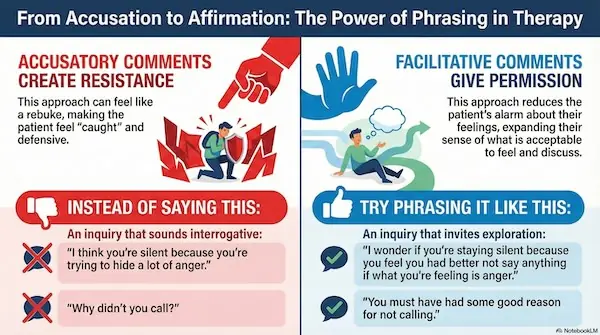
Crucially, always avoid accusatory phrasing—language that implies the patient is deliberately hiding, denying, or being dishonest (e.g., phrasing that makes the patient feel “caught” or humiliated).
3. Seek Clarity, Not Obscurity
Strive for clear language and forsake jargon. The goal is to ensure the message is comprehensible, fostering collaboration. Obscurity of presentation often reflects unclarity of thought and may carry a subtle authoritarian meta-message that intimidates the patient.
II. The Therapist’s Position: Posture and Relationship
The therapist’s stance must reflect honesty about the therapeutic reality: the session is a dynamic interaction between two people, demanding collaboration and measured vulnerability.
1. Be a Collaborator, Not an Adversary
Maintain a non-adversarial posture, positioning yourself as a collaborator with the patient in the struggle against his neurotic difficulties. This prevents the development of an adversarial tone that arises when a patient feels criticized or that they are resisting the therapeutic process.
2. Recognize the Two-Person/Contextual Reality
Adopt a “two-person” perspective, acknowledging that the patient’s experience in session is co-constructed and shaped by the therapist’s participation. The therapist is not a neutral or anonymous observer; rather, she is a participant whose words and actions inevitably influence the patient’s reactions.
3. Practice Judicious Self-Disclosure
While maintaining a professional stance and a protective “safety zone” for self-reflection, strategic self-disclosure can be highly therapeutic. Revealing one’s emotional reactions or rationale can reduce the power imbalance, validate the patient’s subjective perceptions (avoiding a sense of invalidation), and model vulnerability and effective coping—all contributing to a stronger alliance.
III. Practical Communication Pillars: The Core Approach
Effective therapeutic technique lies in the nuances of how insights are communicated, focusing on reducing anxiety and promoting the patient’s ownership of change.
1. Manage the Meta-Message
The meta-message—the implied attitude conveyed alongside the explicit content—is an intrinsic and crucial part of the total communication. Even subtle variations in phrasing, such as substituting “also” for “really” when discussing feelings, can have far-reaching implications, determining whether the comment facilitates change or perpetuates the problem.
2. Affirm Conflict to Reduce Defensiveness
A central strategy is to attend simultaneously to both poles of the patient’s inner experience—the wish for change and the fear that prevents it (e.g., their desire for intimacy versus their anxiety about vulnerability). By acknowledging the patient’s conflict (e.g., “It’s a real bind to be in such a rage toward someone you also love”), the therapist validates the complexity of their feelings, making painful truths more acceptable and reducing defensiveness.
3. Reframing and Relabeling
Use reframing to offer the patient a new, more useful meaning for their behavior or subjective reality. This approach transforms seemingly shameful defects into acceptable characteristics, such as reframing a patient’s emotional withdrawal as an act of integrity or self-protection rather than sabotage. This redirection helps break the negative cycles that maintain the problem.
4. Utilize Attributional Comments
Employ attributional comments to predict or describe the patient’s psychological possibilities. By attributing an insight, capability, or positive action to the patient before it is fully conscious (e.g., sensing they are “getting sick and tired” of a behavior), the therapist lends “ego” to the emerging potential, fostering the patient’s ownership of the change and helping to alienate them from past negative identifications.
5. Focus on Safety and Exposure
The essential goal of communication is to help the patient become less afraid of their feelings, wishes, and inclinations. Therapeutic language must establish a sense of safety, allowing the patient to confront previously avoided material (known as therapeutic exposure) in a controlled environment. This is how profound change is achieved—not through frustration or forced confrontation, but by making it safe enough for the patient to embrace their whole self.
Mastering this essential stance empowers the therapist to find effective and empathic ways to speak her observations, enabling the patient to integrate those insights into a more expansive sense of self rather than feeling humiliated or diminished. By adopting this approach, the words exchanged become the curative tool that facilitates enduring psychological change.