Psychology is the “biography” of consciousness, and cosmogony is the “history” of the matter that allowed that consciousness to exist.
Most psychologies begin with the person — with behaviour, emotion, history, the architecture of the ego. Kabbalah begins one step earlier. It begins with the universe. This is not a poetic flourish; it is a method. As my teacher Mario Sabán puts it, in Kabbalah there is no psychology divided from cosmogony, because before we can ask what is happening in a person, we have to ask which forces constitute that person in the first place. Psychology, in this view, is a reduction of cosmogony — a close-up of a structure that is universal before it is personal.
For those of us working in Transcendent Psychology, this is the starting point that reorganises everything that follows. So it is worth understanding what it actually claims, and why it is more than metaphor.
One contraction, described twice
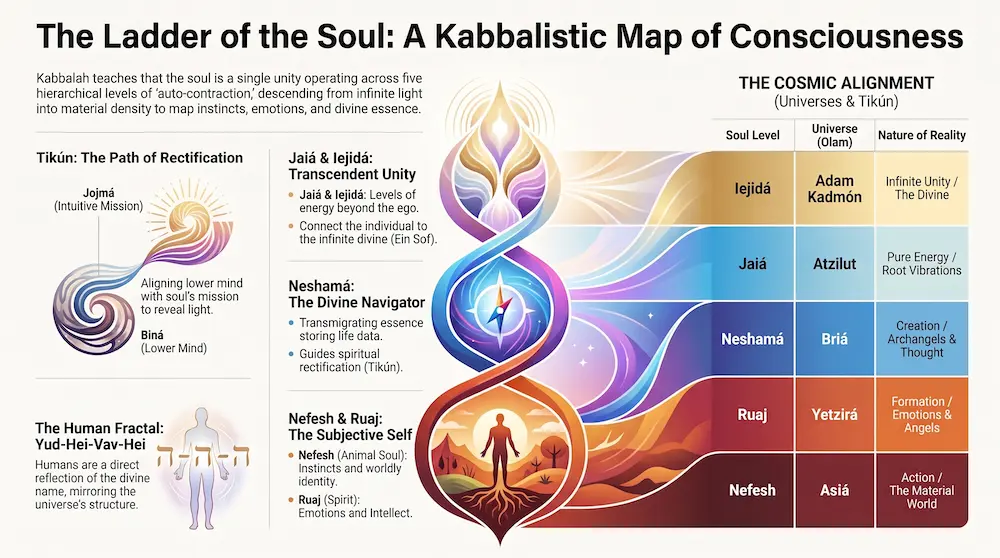
The central idea is deceptively simple. Everything that exists is an autocontraction of the Ein Sof — the infinite — stepping down, level by level, from formless light into material density. The Kabbalists call this primordial self-limitation the Tzimtzum. And here is the move that matters psychologically: the five levels of the soul and the five worlds (olamot) are not two parallel systems linked by analogy. They are the same descent, described from two angles.
Your Nefesh operates in Asiá, the world of action. Your Ruaj operates in Yetzirá, the world of formation. Your Neshamá belongs to Briá, creation. The higher reaches — Jaiá in Atzilut, Iejidá in Adam Kadmón — touch the threshold of the infinite itself. The soul does not resemble the cosmos. It is built by the identical gradient of contraction. This is why Sabán can say that to ask who God is, one need only look in the mirror: the human being is structured as the divine name itself, Yud-Hei-Vav-Hei — the same staged descent the universe underwent.
There is a quiet etymology underneath all of this. Olam, world, comes from nelam, concealment. Every level reveals a little and conceals more. Form is limitation, and only what is limited can be revealed; the formless stays hidden. Most of reality, then, is not absent — it is concealed beyond the reach of our current vessel. Much of what we experience as confusion or contradiction is not pathology. It is the signature of a perceiver who cannot yet hold enough of the field.
The descent, in human terms
Read downward, the levels become recognisable.
Nefesh is instinct — the body’s appetites, the most condensed expression of the soul. (A technical note worth keeping straight: Nefesh is not simply “the body.” A corpse is guf, body without soul. Nefesh is the animating instinctual current.)
Ruaj is the conditioned psyche — emotion, intellect, and above all identity. Sabán’s phrase is the one to remember: in Ruaj, we are what our parents said we are. This is the field of every cultural and familial conditioning we absorbed, and — notably — it is the level at which most of psychology and psychoanalysis actually operates.
Neshamá is the essence beneath the conditioning. It transmigrates, and it stores the data of everything Nefesh and Ruaj have lived. Here Sabán overturns a common teaching: the Neshamá does not need to do its rectification — it already knows what it is. The difficulty is not the Neshamá’s confusion. It is that the Neshamá cannot show itself through the obstructed lower levels — like a mother who loves her child but was raised unable to express it.
Where this becomes clinical
The most useful part of the teaching, for anyone doing inner work, is the account of how the soul’s essence presses into a defended life — and why that pressure so often arrives as symptom.
The Neshamá enters through Keter, the empty crown — and lands first in Jojmá, intuition. It already knows, intuitively, the correction it is here to make. The resistance sits in Biná, the rational, conditioned mind — the loyal defender of the Ruaj’s identity. To Biná, the Neshamá’s arrival feels like sabotage. The results are satisfactory, Biná insists; the strategy is working; do not change. And the Neshamá answers: the results are satisfactory, but you feel empty.
This is a genuinely useful reframe. Symptom, here, is not malfunction. It is the friction of an obstructed essence against a defended self — the same pattern those of us working with parts will recognise immediately. The tradition states this in its starkest form: either we make the Tikún of the Neshamá, or the body eventually expresses the obstruction as illness. I’d hold that last claim as the tradition’s language rather than as a clinical mechanism — but the structural insight beneath it stands on its own.
A psychology of orientation
This is why Sabán insists that a real transpersonal psychology has to reach the cosmogonic. A psychology that only reinforces the ego — without ever asking what the ego is for — does, in his words, real harm. His image is exact: we build a good aeroplane, we train the pilot, we settle the passengers — and then psychology falls silent on the only remaining question. Where is the plane flying? James Hillman made the same demand from inside depth psychology: take the person out of the centrality of the I.
Cosmogony is what answers that question. Not as metaphysics, but as orientation. It gives the work a direction — and it gives Tikún its real meaning. Rectification is not only balancing what is broken. As Sabán renders it, almost as a koan: Tikún is that what you are, you be. The vessel expands; more of what was concealed becomes perceivable; the essence is finally able to show itself through a life that has stopped obstructing it.
That is the whole of it and it begins with the universe, not just the self.