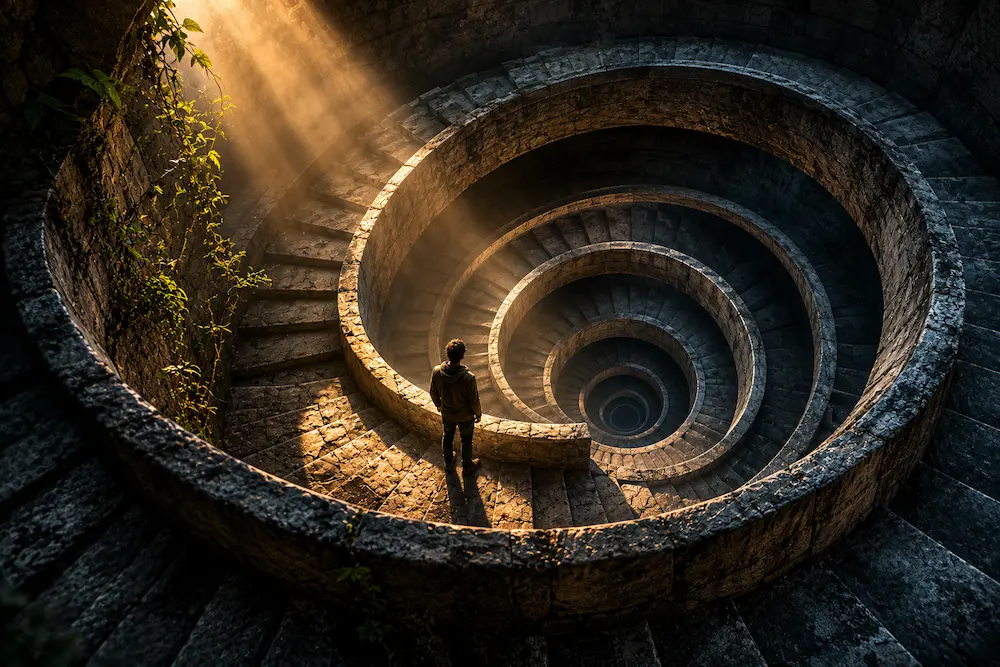
Sacred geometry is often introduced as a collection of intriguing symbols—circles, spirals, mandalas, and repeating grids found in temples, artworks, and spiritual traditions. I have done several talks in the past years where I have approached it from a different angle: sacred geometry as a bridge between how reality is structured and how consciousness experiences reality. In that sense, sacred geometry is not only an aesthetic or mystical fascination, but a practical language for understanding order, balance, and inner integration.
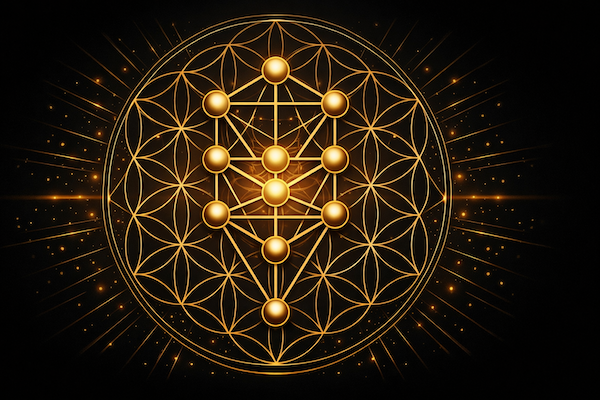
What makes this field so compelling is its simplicity. A symbol as famous as the Flower of Life can be drawn with nothing more than a compass and a piece of paper, yet it evokes patterns that appear across nature and contemplative traditions. The deeper claim—presented in the talk as a hypothesis and experiential insight—is that these patterns don’t only reflect external structure, but resonate with the internal architecture of the psyche and the way consciousness organizes experience.
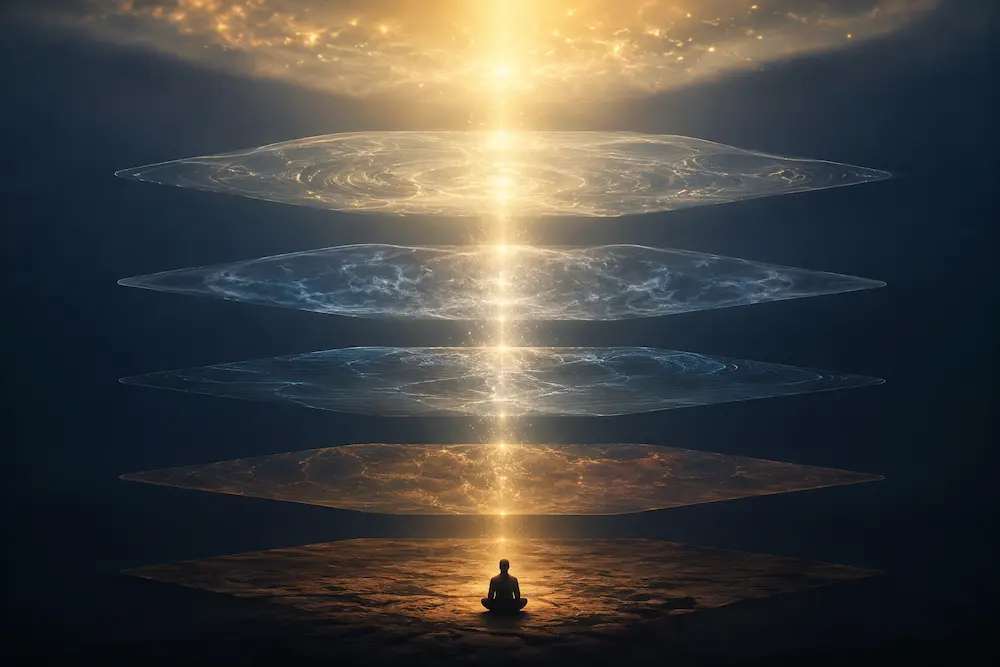
From “Formless and Void” to Structure
To frame sacred geometry, I began with a symbolic origin story: the opening of Genesis, describing a world “without form and void.” This language points to the transition from emptiness into manifested reality—a movement from undefined potential into organized form.
The core proposal in the talk is that this transition is not random. It follows structure. And that structure—repeated across scales and contexts—is what sacred geometry attempts to name visually.
The Flower of Life: A Simple Grid With Big Implications
The Flower of Life is a lattice of intersecting circles. It is visually simple, but perceptually rich: when you gaze at it, your mind begins to “find” multiple patterns inside a single form. That perceptual effect is part of why people often describe it as centering or calming.
In the talk, I described the Flower of Life as a kind of cosmic coordinate system—a “chessboard” on which many structures can be mapped. I also referenced how the pattern is commonly associated with ancient contexts (including the Dendera temple in Egypt) and appears across cultures.
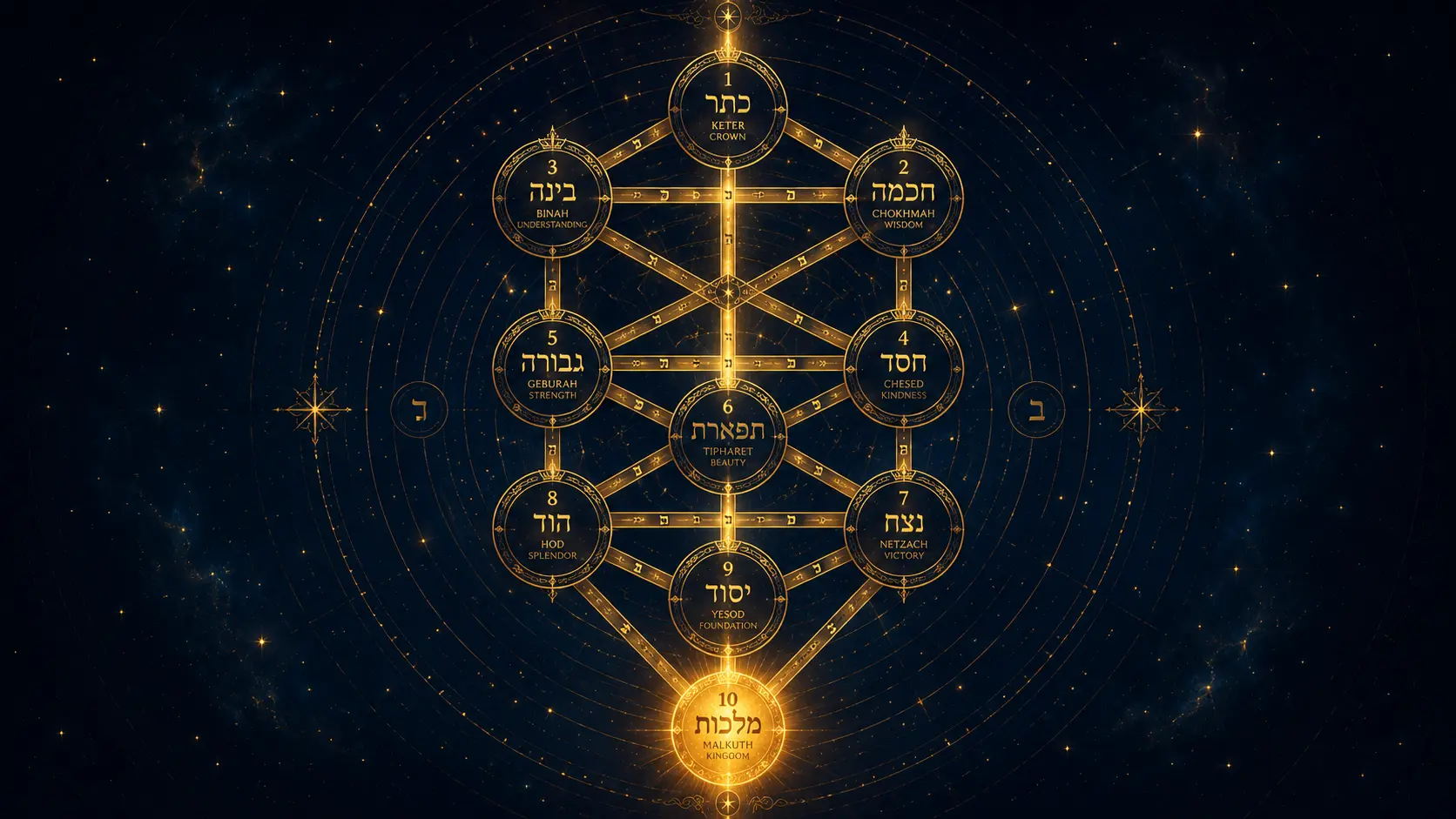
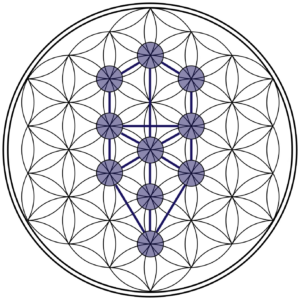
More importantly, the Flower of Life becomes a doorway into a second pattern: the Tree of Life.
The Tree of Life: A Geometric Map of Reality and Psyche
In my presentation, the Tree of Life was introduced as a “blueprint” that maps not only spiritual metaphysics but also lived human psychology—traits, emotional tendencies, and states of consciousness.
One of the reasons the Tree of Life integrates so naturally with sacred geometry is that it is itself a geometric diagram: nodes, lines, symmetry, polarity, and dynamic balance. In the talk, I emphasized that this is not meant merely as intellectual knowledge, but as a practical framework for self-understanding and self-regulation.
Hermetic Principles: A “Lens” for Interpreting Structure
To make the Tree of Life easier to understand, I introduced the Hermetic principles as interpretive laws—mentalism, correspondence, polarity, rhythm, and others—presented as a way to read reality across levels.
In the talk, I highlighted correspondence (“as above, so below”) to explain why sacred geometry so often emphasizes repeating patterns and scale: the intuition that the same organizing logic can appear in the micro and the macro—in the cell, the society, and the cosmos.
Whether one reads these principles as metaphysical truths or as symbolic models, they function as a coherent framework: a way to connect geometry, consciousness, and meaning into a single conceptual map.
Here is an overview of the 7 Hermetic Principles (as presented in The Kybalion):
- The Principle of Mentalism — “All is Mind; the Universe is Mental.”
- The Principle of Correspondence — “As above, so below; as below, so above.”
- The Principle of Vibration — “Nothing rests; everything moves; everything vibrates.”
- The Principle of Polarity — “Everything is dual; everything has poles; opposites are identical in nature, different in degree.”
- The Principle of Rhythm — “Everything flows, out and in; everything has its tides; all things rise and fall.”
- The Principle of Cause and Effect — “Every cause has its effect; every effect has its cause.”
- The Principle of Gender — “Gender is in everything; everything has its masculine and feminine principles.”
Geometry as Balance: Why Symmetry Feels Like Peace
A central claim of the talk is that symmetry and balance are not only visual qualities—they are psychological qualities. When a person is internally balanced—thoughts, emotions, attention, and impulse—there is a felt sense of coherence. I linked this to the experience of sacred architecture and sacred spaces: temples that intentionally harmonize nature, structure, and atmosphere often evoke a state of calm presence.
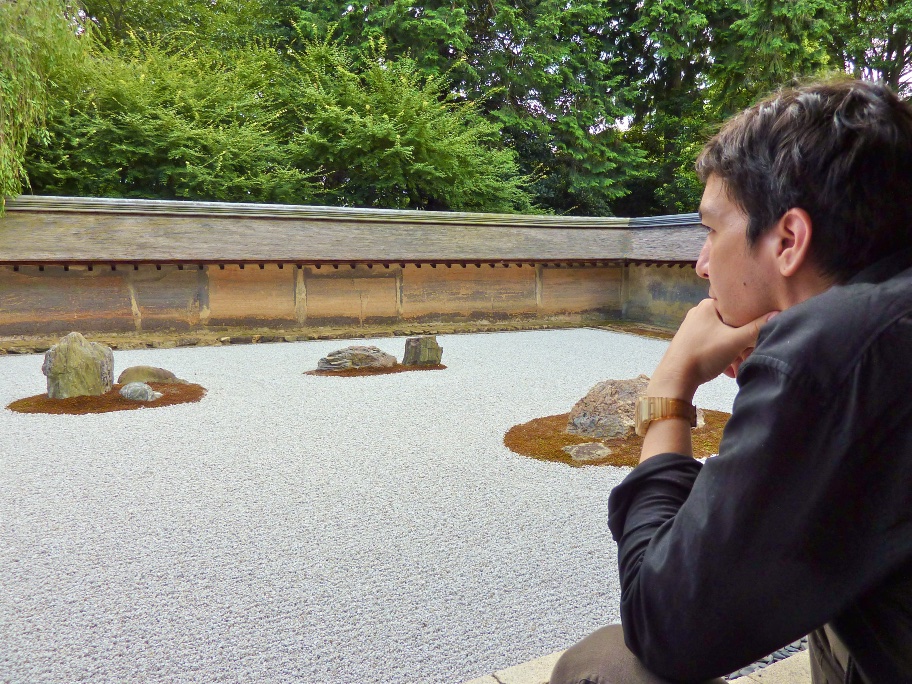
I described personal experiences in places like Japan and Peru, where the felt impact was not excitement but an “unexplainable” tranquility—an immediate settling into presence. The interpretation offered was that sacred geometry is one of the hidden design principles that can entrain this experience: order outside can invite order inside.
This is one of the temples in Japan where I could experience the inner peace relationship with balance in space. The positioning of the stones are arranged in a way that their proportion seems like observing small islands in a vast ocean within the wabisabi walls of the garden. The place is so powerful that the balance of the objects arranged in the space produce an instantaneous state of inner peace.
A Bridge Into Psychology: Integration, Imbalance, and Regulation
One of the aspects I emphasize the moste is building the bridge between mystical models and psychological language. I spoke about imbalance as a kind of “uneven distribution of energy” in the Tree of Life, and framed integration as restoring flow and equilibrium across polarities.
To translate this into contemporary terms, I referenced neurofeedback imagery and the idea that certain patterns of dysregulation correlate with measurable imbalances. The key point was not to claim that ancient diagrams “prove” neuroscience, but that they can function as maps for self-observation:
- Where am I over-identified with control, analysis, or fear?
- Where am I disconnected from emotion, intuition, or relational softness?
- What would balance look like as a daily practice?
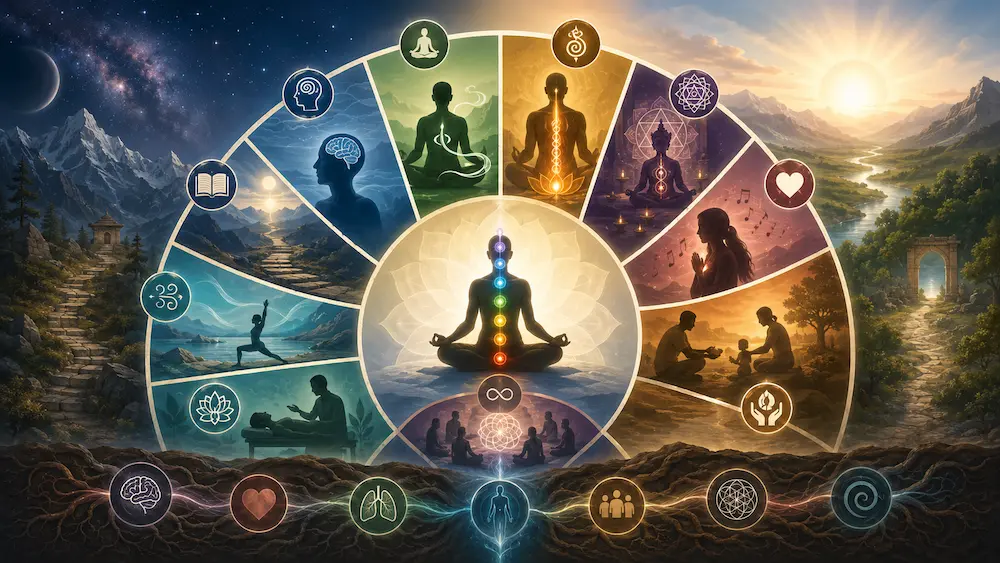
In this framing, sacred geometry becomes less about belief—and more about training perception and cultivating integration.
Mandalas, Fractals, and the Unconscious
The talk also explored sacred geometry as something encountered in altered states—particularly through mandalas and fractal imagery. I referenced Jung’s view of mandalas as psychologically meaningful symbols and described using mandalas as tools for introspection in retreats.
From this perspective, mandalas are not only cultural artifacts; they are contemplative technologies. When you focus on them, they can evoke associations, emotional material, and insight—sometimes immediately.
This theme extended into psychedelic experience, where sacred geometric visions were described as part of the “booting” process of the experience—like the mind revealing a hidden operating system. In the talk, I framed this as a connection to deeper structures of the unconscious—an experiential sense that patterns contain information even if we can’t immediately interpret it.
What Sacred Geometry Offers in Practice
If sacred geometry is only treated as a set of claims (“this pattern explains everything”), it can become abstract or polarized—either blindly believed or quickly dismissed. But if it is treated as a practice and a language, it becomes immediately useful.
Here are practical applications consistent with the talk’s orientation:
- Meditative attention training Use a simple pattern (Flower of Life, a personal mandala) as a focus object. Notice what it evokes in the body and mind.
- Integration through balance Use the Tree of Life as a reflective diagram: identify where you over-invest energy and where you under-nourish your system.
- Environmental design Notice how symmetry, rhythm, proportion, and coherence in a space change your internal state—especially in ritual or retreat settings.
- Meaning-making without forcing certainty Treat symbolic correspondences as hypotheses that guide inquiry, not as dogma. Let the pattern invite a question rather than impose an answer.
- Cosmogonic understanding Connecting cosmogony with an understanding of the foundational structure of physical and spiritual reality.
Conclusion: The Real Value Is the Return to Coherence
Ultimately, the importance of sacred geometry is not that it “proves” a single worldview. Its real power is that it reminds us—visually, symbolically, and experientially—that coherence is possible.
Sacred geometry gives form to an intuition many traditions share: when life becomes chaotic, the task is not to control everything, but to restore alignment. Balance. Harmony. A stable center. In that sense, sacred geometry becomes a mirror: not only showing patterns “out there,” but revealing what it feels like to become patterned, integrated, and present within oneself.