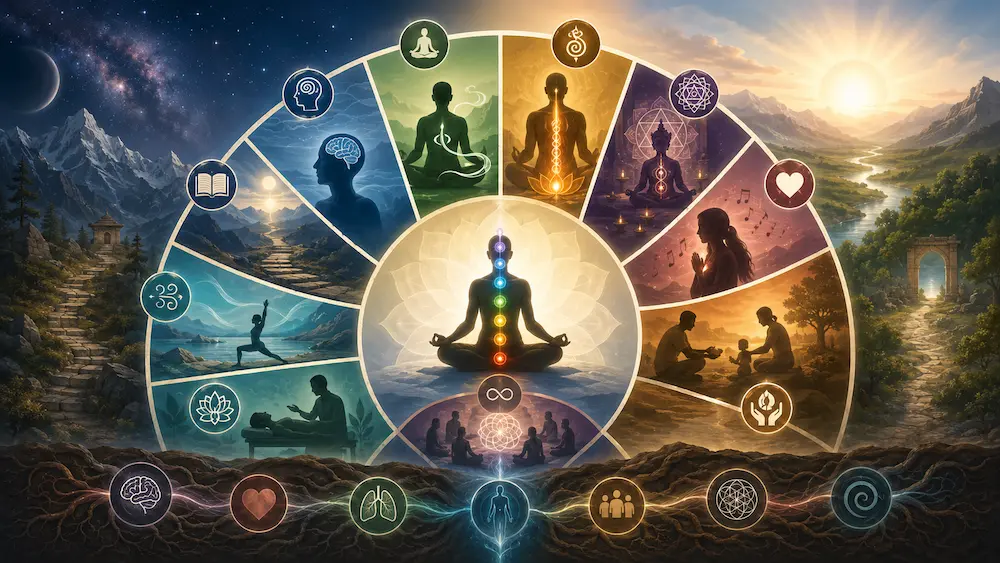
When most people in the West hear the word yoga, a single image appears: a body folding into a posture on a mat. That image is not wrong, but it is a small window onto a very large house. Yoga is not one thing. It is a family of traditions — philosophical, psychological, devotional, energetic, ethical, and therapeutic — developed over thousands of years, each answering a different question about what a human being is and how a human being changes.
At the Transcendent Institute we draw on yoga deliberately. We use some of its currents as the backbone of daily practice, treat others as background philosophy, and hold a few at a respectful distance. This article is the map: what the wider territory contains, where our own work stands on it, and why we make the choices we do. It is written for the newcomer; practitioners will find the technical detail in the notes.
What yoga is in this work
The Sanskrit root of the word — yuj — means to yoke, to unite, to integrate. In our framework, yoga is treated as an inner science of regulation and awareness: a systematic, experiential method for studying the mind and steadying the nervous system. Not a religion (it requires belief in no deity), not a fitness routine (posture is one tool among many), not a performance of flexibility.
The “union” yoga points to has three layers, and each one matters to us:
- Union of body and mind — returning awareness to the body, which most of us have largely left.
- Union of self and observer — recognising that something in us watches experience without being identical to it. Patanjali calls this the drashta, the seer.
- Union with the whole — the felt sense of belonging to something larger than the separate self.
Held this way, yoga is less a belief system than a set of instruments for self-knowledge. You do not have to accept any metaphysical claim to use them — no more than you need to understand acoustics to be moved by music.
A field map of the currents
Here is the wider territory. The tradition can be grouped into a handful of families, each with a different centre of gravity. (Sanskrit terms and finer distinctions are in the notes.)
The philosophical and contemplative currents ask Who am I, really? Advaita Vedanta and the path of knowledge (Jnana Yoga) inquire into the difference between the changing self and the awareness in which change appears.[1] Their gift is clarity. Their risk, when practised prematurely, is intellectualised detachment — insight that floats above unintegrated emotion.
The psychological and meditative currents study the mechanics of mind. Patanjali’s classical yoga — often called Raja Yoga — maps the mind’s fluctuations (vrittis) and the disciplined path of stilling them.[2] This is the most directly psychological strand, and the one our work leans on most heavily.
The psychophysical currents work through body and breath: Hatha Yoga, pranayama, asana. Here the body is not an obstacle to transcend but the instrument through which the nervous system is regulated and the mind prepared for stillness.[3]
The energetic and subtle-body currents — Kundalini, Kriya, and much of Tantra — work with prana, the chakras, and the awakening of latent energy.[4] These are the highest-voltage practices in the tradition, and the ones that most reward caution — a point we return to below.
The devotional and ethical currents — Bhakti (the path of love and surrender) and Karma Yoga (selfless, non-attached action) — transform the practitioner through the heart and through conduct rather than through analysis.[5]
The modern therapeutic and integral currents adapt yoga for health, trauma recovery, and nervous-system regulation, or attempt — as the Bihar School of Yoga does — to synthesise the whole field into a single graded curriculum.[6]
These families overlap and borrow from one another; the boundaries are real but porous. What matters for a student is that “yoga” never names a single technique. It names a landscape.
Our working compression: the four pathways
To make this landscape usable, we organise our relationship to it through the four classical pathways popularised for the modern world by Swami Vivekananda.[7] Each corresponds to a psychological orientation:
- Jnana — the path of insight. Inquiry into the nature of the self. Its psychological cousins are metacognition and identity restructuring.
- Karma — the path of action. Service without attachment to outcome. Its cousins are values-based action and the loosening of ego-driven striving.
- Bhakti — the path of devotion. Love and surrender. Its cousins are attachment repair and the reorganisation of emotional life around meaning rather than fear.
- Raja — the path of meditation. The disciplined regulation of attention, and the strand from which our practical methods are drawn.
These four are not rival teams to pick from. They are temperamental doorways into the same room.
Where yoga actually lives in the program
This is the part that answers the practical question — how does yoga apply to what we do? The answer is unusual, and worth stating plainly: yoga is the one tradition in our work that touches two of our Three Pillars at once.
In Pillar Two (Integral Health), yoga appears as a regulation technology — pranayama and somatic awareness sit alongside sound and lifestyle as ways of restoring balance to body, breath, and nervous system.
In Pillar Three (Mystical-Spiritual Traditions), the same tradition reappears in a different role: yogic science as a map of consciousness, standing beside Kabbalah’s Tree of Life and the Andean Chakana as one of three symbolic cartographies of the inner world.
So yoga is at once a set of tools for steadying the system and a philosophy for understanding it. That double role is why it runs through the program from the very first day. The four practices taught in Level 0 are each chosen for a specific regulatory function:
| Practice | Traditional understanding | What it supports in the body |
|---|---|---|
| Pranayama | Regulation of prana through breath | Activates the vagus nerve; parasympathetic recovery |
| Meditation | Stilling the vrittis; cultivating the witness | Associated with reduced amygdala reactivity and a quieter default-mode network |
| Mantra | Anchoring attention through sound | Vibrational resonance and attentional state-change |
| Asana | Preparing the body for stillness | Releases held tension; improves interoception |
These physiological associations point in a well-established direction, though the size and durability of the effects vary considerably across studies. We hold them as real but not magical — instruments that reliably help, not guarantees.
Even the name of our opening level is yogic: Sat Nam, the gateway level, is a Kundalini-yoga invocation meaning True Name or True Identity — the question the whole program begins with. Worth noting for precision: this is a mantra, an attentional anchor. It is not the same as the intensive kundalini activation practices described below.
What we foreground, and what we hold lightly
Honesty about this matters, because not all of yoga is equally suited to a self-leadership program that serves people carrying trauma.
We foreground the regulating, awareness-building, and inquiring currents: breath, meditation, body literacy, the disciplined study of the mind, and the transformation of emotion through devotion and of motivation through non-attached action. These are robust, broadly safe, and integrate well with depth psychology.
We hold the high-voltage energetic and ritual currents — intensive kundalini activation, advanced bandha and mudra, tantric ritual — more lightly, and we do not offer them as entry points. This is not dismissal; it is sequencing. Such practices can destabilise an unprepared system, traditionally require direct transmission, and ask for a steadiness that has to be built first. It follows a principle that runs through the whole program: every higher-level insight requires a lower-level integration. Expanded states without embodied grounding remain abstract, and can do harm. We anchor transcendence in the body and in daily life, on purpose.
Four maps, one territory
In our materials we say that the frameworks we draw on — psychology, yogic science, Kabbalah, Andean cosmovision — are not competing truths but complementary maps of the same interior territory. Yoga’s particular contribution is a vertical one: a model of consciousness that reaches beyond personality, paired with practices precise enough to steady the body while that exploration happens. Psychology supplies the horizontal work — relationship, behaviour, the integration of what is found.
The goal we take from yoga is modest and practical. Not enlightenment, not mastery. A greater capacity to be present: to inhabit the body, observe the mind, and meet experience with something closer to curiosity than reaction. Sustained over time, that shift is its own quiet transformation.
Notes for practitioners
[1] Advaita Vedanta holds the identity of Atman (the true Self) and Brahman (absolute reality); suffering arises from avidya (ignorance), specifically the misidentification of the Self with body-mind phenomena. Methods: viveka (discernment), vairagya (dispassion), neti-neti (“not this, not this”). The standard caution in trauma-sensitive contexts is that non-dual de-identification can shade into dissociation or spiritual bypassing if emotional and somatic integration are skipped.
[2] Patanjali’s Yoga Sutras define yoga as citta-vritti-nirodha — the stilling of the fluctuations of the mind-field. The system rests on a Samkhya metaphysics distinguishing purusha (pure consciousness) from prakriti (nature/mind/matter), and its eight limbs (ashtanga) run from ethical foundations (yama, niyama) through breath and sensory withdrawal to concentration, meditation, and absorption (samadhi).
[3] Classical Hatha texts include the Hatha Yoga Pradipika, Gheranda Samhita, and Shiva Samhita. Patanjali’s own definition of asana — sthira sukham asanam, “steady and comfortable” — says nothing about difficulty; the posture exists to let one sit for meditation. Modern postural yoga is largely a twentieth-century development and should not be confused with the classical system.
[4] Distinguish carefully: Kundalini as a mantra and meditative lineage differs from intensive kundalini activation. The latter, along with advanced bandha/mudra and tantric ritual, carries a documented risk of destabilisation and traditionally requires preparation and diksha (initiation). Tantra should not be reduced to sexuality, nor Hindu and Buddhist Tantra conflated.
[5] In Bhakti, transformation comes through prema (love), surrender, and practices such as kirtan and japa; the risk is dependency or passivity when discernment is absent. In Karma Yoga (central to the Bhagavad Gita), action is offered without attachment to its fruits; the risk is using “selfless service” to rationalise overwork or self-neglect.
[6] The Bihar School of Yoga (Satyananda) is a useful integral reference, especially for Yoga Nidra — a pratyahara-based relaxation method with real therapeutic and trauma-sensitive applications, provided deep relaxation is handled with care, since it can surface unresolved material.
[7] On attribution: the four paths are far older than Vivekananda — the Gita already discusses knowledge, action, and devotion. His contribution was to package them as four parallel “yogas” for a modern, largely Western audience in the 1890s. “Popularised” is more accurate than “systematised.”
Blog deliverables (strip before publishing)
SEO title: The Many Yogas: A Field Map of the Tradition Alternates: “Which Yoga? A Field Map for Inner Work” · “Types of Yoga, and Where They Fit in Inner Work”
Meta description: Yoga is not one thing but a family of traditions. A field map of yoga’s main currents — and where each one lives in the work of Transcendent Psychology. (158 chars)
Category: Transcendent Psychology Tags: Yoga · Yogic Science · Self-Leadership · Contemplative Practice · Nervous System Regulation
Internal link suggestions (anchor → target):
- “studied yogic philosophy in Rishikesh” → Studying Yogic Philosophy and Science in Rishikesh (companion philosophical piece — strongly recommended)
- “Tiferet, the heart-self” → Tiferet: The Heart of the Tree of Life
- “the Eight Cs of the Self” → The 8 Cs of the Self
- “the layers of identity” → Levels of Self: Evidence-Based Research on the Multiple Layers of Identity
- “meditation as awareness training” → Meditation: The Art of Doing Nothing
Thumbnail prompt (photorealistic, Midjourney/DALL·E):
Photorealistic overhead shot of a weathered antique map laid on a dark wooden table, but instead of geography the map shows softly glowing interconnected paths and nodes resembling a tree and a stepped cross; a single lit candle, a small brass singing bowl, and a folded grey wool blanket rest at the edges; warm low side-lighting, deep navy and muted gold palette, shallow depth of field, contemplative and grounded mood, no text, no people. –ar 16:9