A free 10-minute reflection tool in the language of Internal Family Systems, for anyone curious about their inner world and for the professionals who accompany that work.
Most of us assume that one person is in charge of our inner life: me. An ordinary day says otherwise. There is the one who plans tomorrow before today has finished, the one who replays a conversation and finds every mistake in it, the one who says yes while the body says no.
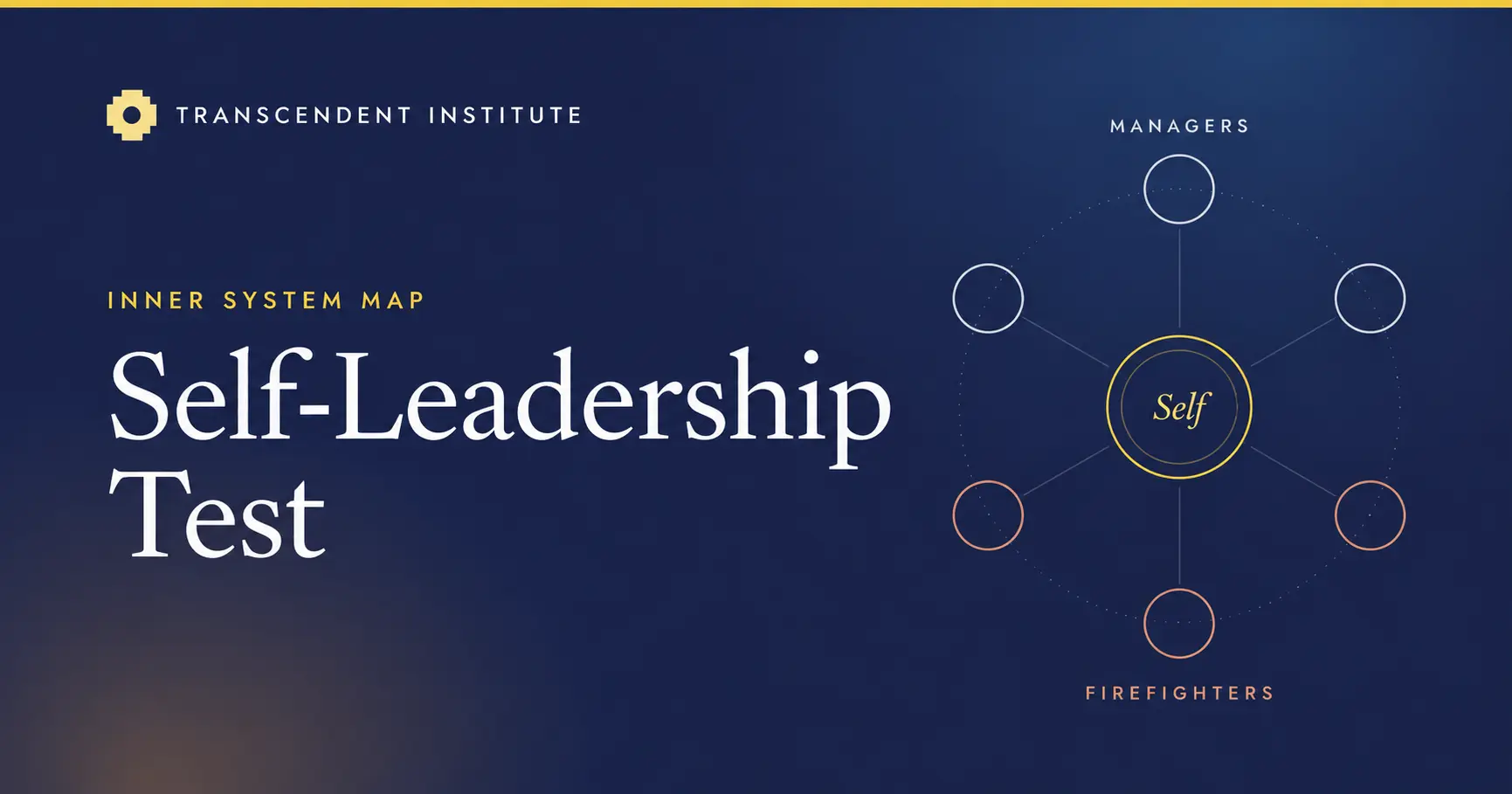
Internal Family Systems (IFS), the model developed by Richard Schwartz, takes this multiplicity seriously. It describes the mind as a system of parts around a core Self. Managers protect proactively by organising daily life. Firefighters protect reactively when pain breaks through. Exiles are young parts carrying old burdens, kept out of sight. None of them is bad. Each formed for a reason. Self-leadership means that the parts trust the Self enough to relax, so that the Self can lead.
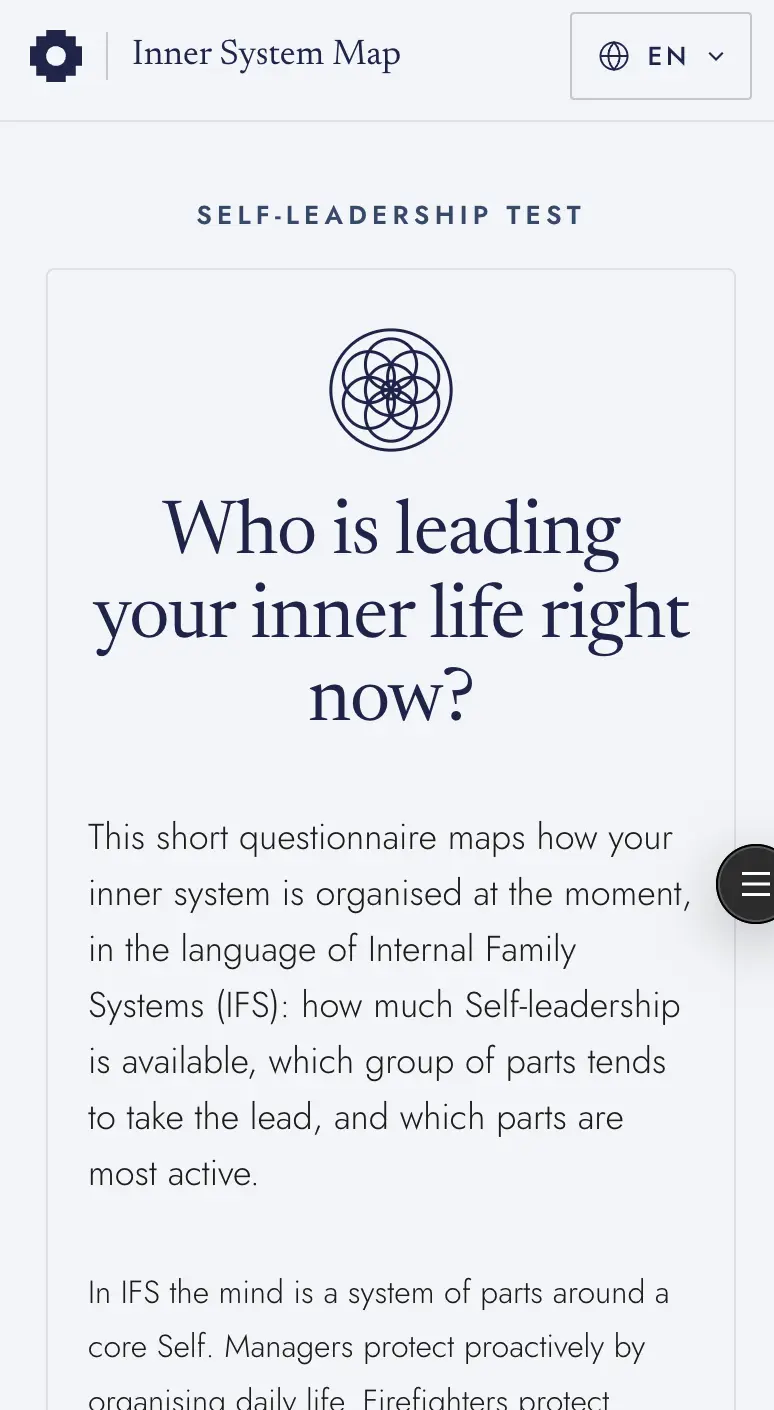
The Inner System Map is a short questionnaire built around the question at the centre of our Self Leadership Program: who is actually leading right now? It is open to anyone at selfleadership.transcendentinstitute.com.
A map, not a type
IFS does not type people. Nobody is “a Perfectionist”. A person has a part that uses perfectionism as a strategy. So the map gives no label. It shows three things:
- How much Self-leadership is available.
- Which group of parts tends to lead, described as one of six patterns: Self-led, Managed, Reactive, Polarised, Flooded, or Quiet or Guarded.
- Which parts are most active, among fourteen common protector strategies (the Perfectionist, the Critic, the Pleaser and others) and five themes that exiles often carry.
Each protector is described through its strategy, the wound it may be protecting, and its cost over time. The reflection prompts are addressed to protectors only. As Schwartz puts it in No Bad Parts: “We don’t go to exiles without permission from protectors.”
How it works
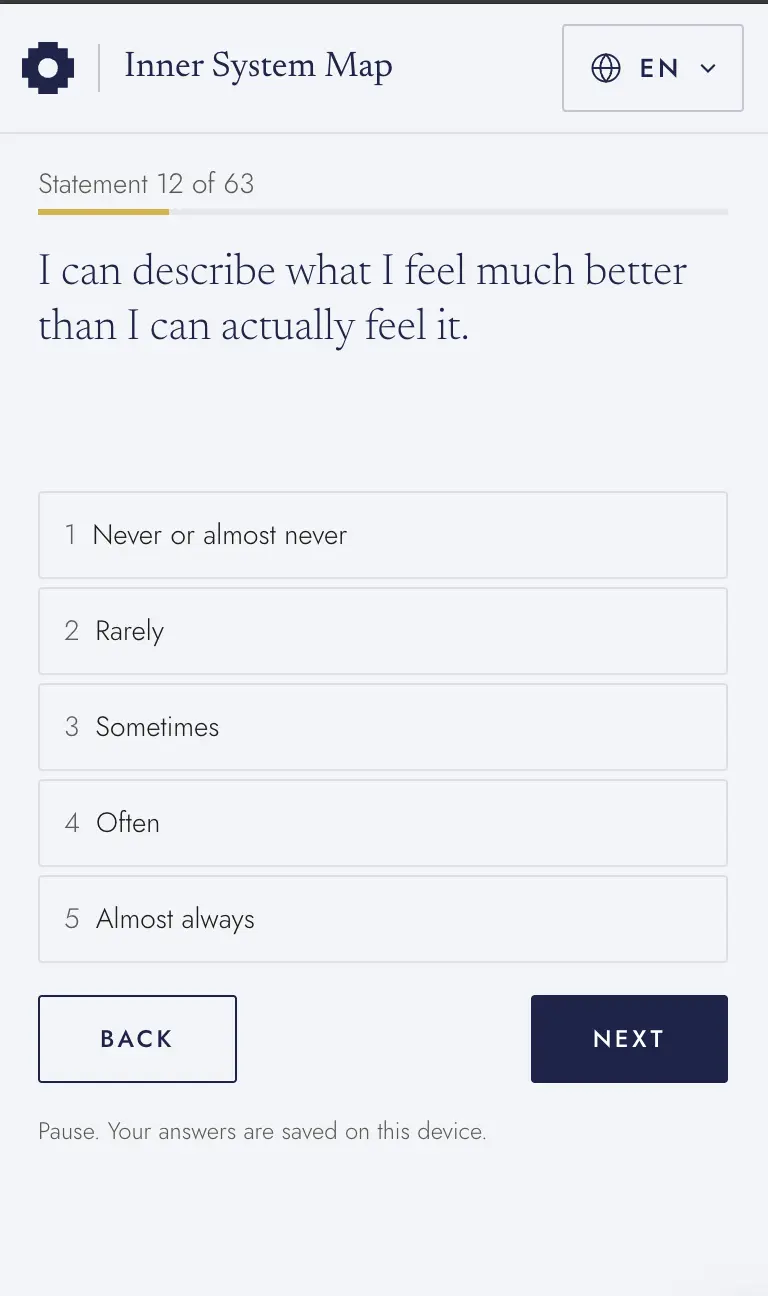
- 63 short statements, about 10 minutes, answered for how you have actually been over the last six months.
- Results appear on screen and arrive by email as a PDF.
- Available in English, Spanish, Romanian and Turkish, for adults aged 18 or older.
- A copy is kept for six months in the European Union, and you can delete it sooner from the email.
A note for therapists and IFS practitioners
The map is a reflection aid, not a validated psychometric instrument. It has no norms, its thresholds are heuristic, and it does not assess or screen for any condition. That includes risk: it deliberately asks nothing about self-harm. As a self-report it sees only the parts a person is already aware of, and a capable manager can answer on the Self’s behalf. Every result is a hypothesis to check with the part.
It is also not the IFS Scale, the 57-item instrument developed by Lia DeLand in collaboration with Richard Schwartz and offered to trained IFS clinicians. The Inner System Map is an independent project, not affiliated with the IFS Institute. If you try it, with yourself or with clients who choose to share their results, we would value hearing where it helps and where it misleads: [email protected].
How is the test built
The Self Leadership Test is a small web application built for one job. The statements are shuffled for every attempt, your progress is saved as you go, and your answers are scored in your browser the moment you finish. The results are then laid out as a map and delivered as a PDF, in your language, with the same reviewed text on screen and on paper. Underneath, the scoring engine is covered by automated tests, including fixed reference results that fail the build if any score drifts, and each release runs an automated accessibility check so the questionnaire works with keyboards and screen readers. The same engine serves the public tool and the cohort version used in the Self Leadership Program, where participants sign in with a one-time code and can see their attempts side by side over time.
Going deeper: the Tree of Life Test
The Inner System Map concentrates on the Self: how much of it is available, and which parts lead in its place. For those who want to go deeper, the Tree of Life Personality Test uses a different lens: the ten sefirot of the Kabbalistic Tree of Life. In 60 questions and about 10 minutes, it looks at where a person is in balance and where not, psychologically and spiritually.
It is not an IFS tool. The link between the two, in which the Self corresponds to Tiferet, the heart of the Tree, is our school’s own synthesis. It too is a reflection aid, not a validated instrument.
The first step
The Inner System Map will not tell you who you are. It can show you who has been speaking for you, and make the next question easier to ask: what is this part protecting, and what would it need in order to trust you to lead?
Take the Inner System Map Test (about 10 minutes, free).
Both tools are self-report reflection aids. They are not therapy, not diagnostic instruments and not a substitute for professional support.
References
- Schwartz, R. C. (2021). No Bad Parts: Healing Trauma and Restoring Wholeness with the Internal Family Systems Model. Sounds True.
- IFS Institute. IFS Scale (L. DeLand). ifs-institute.com/resources/research/ifs-scale
Sources: