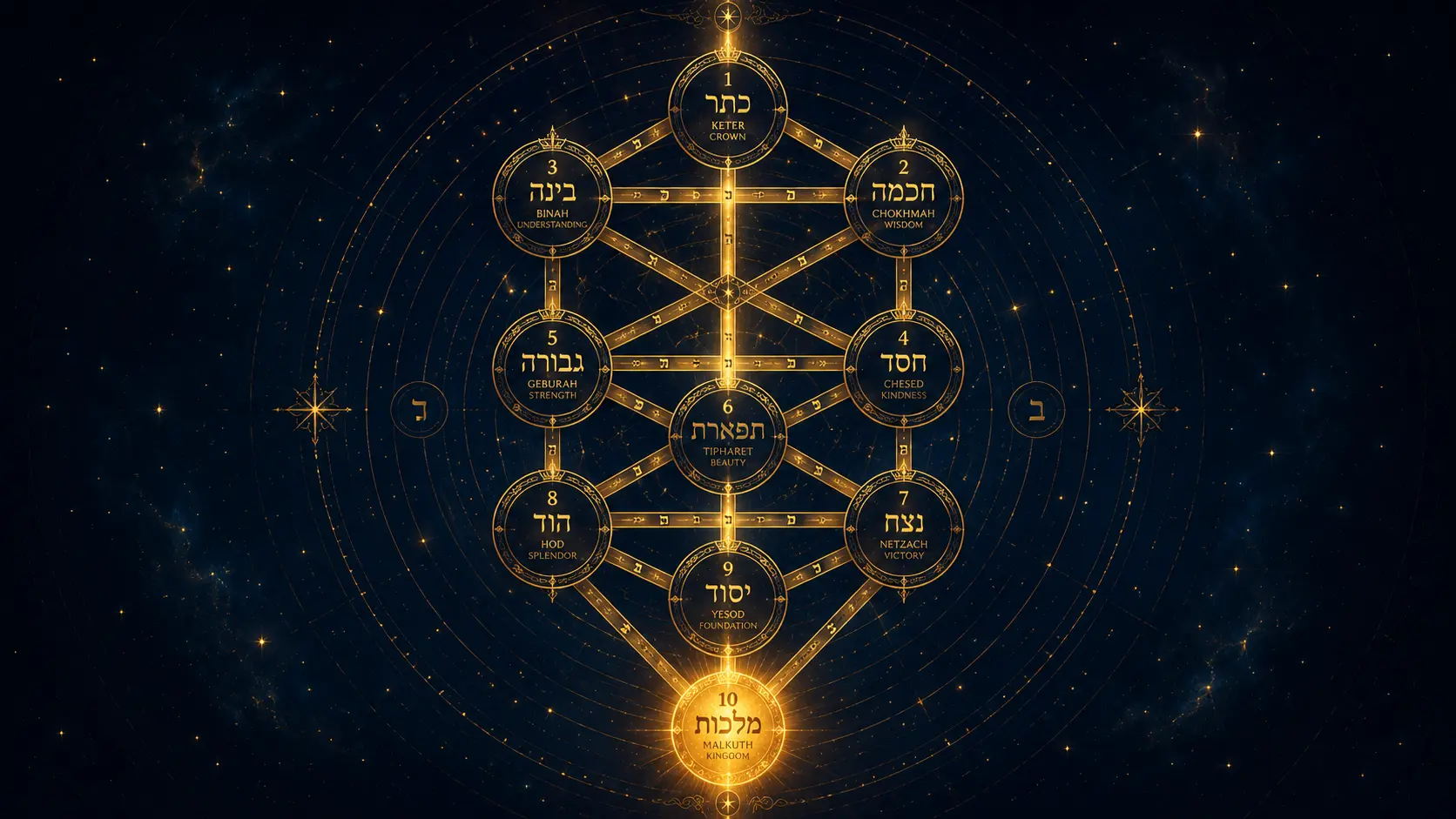
Introducing the new Tree of Life Test that examines your sephira of Malkuth
There is an old habit in spiritual life of looking upward. We reach for the crown of the Tree, for light, transcendence, unity — for the part of ourselves that feels closest to the divine. And then we come back down into a body that is tired, a bank account that needs attention, a kitchen that needs cleaning, and we quietly treat all of that as the unspiritual part of life. The part we have to get through so we can get back to the real work.
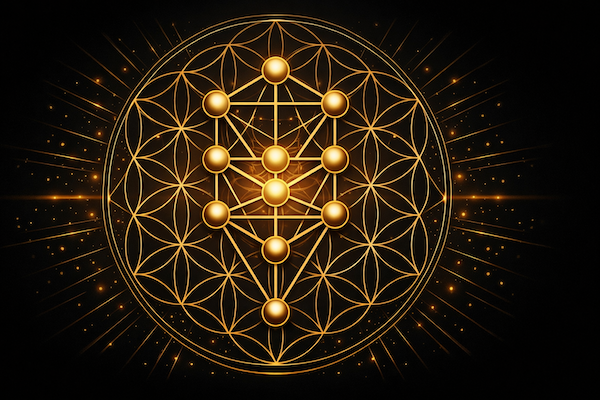
Kabbalah turns this instinct on its head. At the very bottom of the Tree of Life sits Malkuth — the Kingdom — and the whole tradition insists that this is where everything actually happens. Not despite being the lowest sephirah, but because of it. Malkuth is the one door through which everything above has to pass to become real. A vision you never live is not spirit; it is, as we like to put it, a rumor.
This article is an introduction to Malkuth as a psychological and spiritual dimension: what it is, why the Institute treats it as the ground of inner work rather than an afterthought, and what it asks of us in ordinary daily life. You can also do the test below to see how you are doing in your Malkuth dimension.
Where am I? The sephirah of embodiment: Discover the new test
If the first question of the inner path is Who am I? — the question of the Self — then the next question is quieter and more concrete: Where am I? Malkuth is the answer. It is the sephirah of the body, of matter, of presence in the here-and-now.
A few of its traditional coordinates help locate it. Malkuth sits at the base of the central pillar of the Tree, and it connects to everything above it directly through Yesod (Foundation). In the classical scheme of four worlds, it belongs to Asiyah, the world of action. Among the levels of the soul it corresponds to Nefesh, the vital, embodied soul — the layer closest to breath, instinct, and biology. Its symbol in the body is the feet: what makes contact with the earth. And it is traditionally the dwelling place of the Shekhinah, the indwelling divine presence in the world.
There is a small piece of numerical poetry the tradition loves here. Malkuth is the tenth sephirah, and ten is written 1 and 0 — the 1 of Keter, the crown, and the 0 of the infinite from which everything comes. Read that way, the Kingdom already contains the crown it seems to have fallen so far from. We are not as far from the source as we feel. We just have to notice that we are standing in it — with our feet on the ground.
The new test is here and with it you can discover more how your energy is in the sephira of Malkuth, this one I designed recently, and free to use. This is the first of a series of upcoming Tree of Life Tests that zoom in the sephirot. This time we start with Malkuth. Feel free to try the test and see your results here: https://malkuth.transcendentinstitute.com/
Matter is not the enemy
This is the teaching that most surprises people who come to Kabbalah expecting a flight from the material world. Malkuth departs sharply from any spirituality that treats the body as a prison and the earth as a place to escape. As one teaching image puts it: if matter had not been important, we would have been created as angels. We were not. We were given bodies and set down inside a physical world, and that was not a mistake to be corrected.
The task, then, is not to transcend matter but to bring consciousness and dignity into it — to spiritualize matter through action. This is why, at the Institute, a curriculum about the soul deliberately begins with the body. You cannot lead a life you are not present to, and you are not present anywhere but here, in this flesh, in this room.
Needs, values, and the great confusion
Malkuth also gives us one of the most useful everyday distinctions in the whole framework: the difference between a need and a value.
Needs are real, material, and finite — food, shelter, safety, rest, enough money to live with dignity. Contempt for these is itself a distortion; the body and its needs deserve care, not disdain. And a genuine need has a particular signature: once it is met, it goes quiet.
Values are different in kind — love, truth, connection, growth, contribution. They are not satisfied and set aside; they are lived, continuously.
Much of modern unhappiness, in this reading, comes from a quiet category error: we take a manufactured want, dress it up as a need, and then chase it endlessly — and it never satisfies, because there was no real need underneath it. Or we ask an object to carry a value it was never built to hold. The practical question Malkuth keeps putting to us is simple: Is this a need I can meet and let rest — or have I quietly asked a thing to make me whole?
Idolatry: when the object becomes the subject
The classic distortion — the klipah, or “husk” that obscures the light — of Malkuth is defined with unusual precision: idolatry is the transfer of power to an object. The image is the golden calf. The calf itself was harmless metal; the trouble began the moment power was handed over to it.
Owning shoes is fine. The distortion arrives when, as we say, the object becomes the subject — when the thing starts running the person. Its contemporary forms are familiar: consumerism, productivity as identity, body obsession, money as salvation, a life organized around survival long after survival is secure.
And here is the crucial clarification for anyone tempted to swing to the opposite error: matter can lift a person out of poverty and deliver real stability — and stability is not to be despised. But stability is not the same as meaning. A great deal of suffering comes from placing our hope where hope cannot rest, and discovering the emptiness that can follow material “success.”
So Malkuth is not honored by rejecting matter, and it is not honored by worshipping it. Its health is a middle measure — the midah — of using material things well, as tools: caring for the body from appreciation rather than fear, treating money and work as instruments of genuine improvement, and accepting the real limits of matter without either fighting them or collapsing into them.
Self-leadership begins in the body
Why does the Institute treat this dense, practical sephirah as the ground of self-leadership? Because leadership of your inner life is not primarily a matter of thinking better. It is a matter of being present.
Self-leadership, as we use the term, is the capacity to relate consciously to whatever arises in you — rather than being run by emotion, reflex, and old adaptation. It is not control or suppression; white-knuckling a feeling into silence is just another way of being at war with yourself, and buried feelings keep running the show from underground. It is the capacity to stay with experience — to feel it, witness it, and choose a response from that presence.
That capacity lives in the body first. A dysregulated nervous system cannot lead; it can only react or shut down. Much of the early work is simply learning to name your state — settled, activated, or collapsed — because in that small act of recognition a sliver of freedom opens. “I’ve dropped into shutdown” is already the beginning of leadership.
Here one contemporary bridge the program finds fruitful is worth naming honestly as a bridge. Internal Family Systems (IFS) describes the psyche as naturally made of parts around a core Self. In our teaching, the material domains of Malkuth — body, money, work, matter, earth — become an unusually honest mirror for those parts: money anxiety, a productivity compulsion, chronic body-neglect, the habit of never finishing what we start. Each is a concrete doorway to a protective pattern, and behind it, usually, something younger and more tender. This mapping between Kabbalah and IFS is a symbolic-psychological reading the Institute uses because it works in practice — not a claim that either tradition contains the other.
From insight to action
Malkuth’s final demand is the hardest and the simplest: what is not practiced remains potential. Insight that never descends into action is not yet real. The whole Tree has to reach the ground — and so does whatever you have understood about yourself.
The way it reaches the ground is almost disappointingly ordinary. Small and consistent beats large and rare. Begin smaller than you think you need to. Choose one insight, and ask what single action would embody it this week. That is Malkuth: not the grand realization, but the finished, lived, materialized version of it.
The crown needs a kingdom
There is a line the tradition returns to again and again: there is no crown without a kingdom. The most exalted heights of the Tree mean nothing until they reach all the way down into a life. The two ends mirror each other — the 1 and the 0, the crown already folded into the Kingdom.
To work with Malkuth, then, is not to abandon the spiritual for the mundane. It is to discover that the ground under your feet was never the opposite of the sacred. It was where the sacred was always trying to arrive.
A few questions to sit with
- What place do material things really have in my life?
- Do I care for my body from appreciation, or from fear?
- Do my projects descend into action — or stay potential?
- Where do I resist the honest limits of matter?
- Where might I have handed my power to an object?
- Which state is my nervous system in right now — settled, activated, or shut down? (Just name it. You don’t have to fix it.)
- One insight I already have: what single action would embody it this week?